
Searching for box van trailers for sale can feel impossible when classified listings omit half the specs you actually need. No internal dimensions. No GVW. No response from the seller. It is a frustrating experience that costs buyers real time and, when they rush a decision, real money. If you are a tradesperson, a small business owner, or simply someone who needs a reliable enclosed trailer for regular work use, you deserve better than that.
This guide cuts through the noise. By the end, you will know which specs to check before you shortlist anything, what new and used box van trailers realistically cost in the UK right now, how UK towing rules apply to your licence and your vehicle, and the mistakes that send buyers back to square one. We will also explain why RightFit Trailers is worth bookmarking before you spend another afternoon on classifieds.
The specs that determine whether a box van trailer does the job
Most buyers start with price. That is the wrong place to start. Before you shortlist a single trailer, you need to understand three things: internal dimensions, payload, and gross vehicle weight (GVW). A trailer that looks perfect in a listing can be completely unsuitable if its GVW exceeds your car’s towing capacity, or if the internal height does not accommodate what you are transporting.
Internal dimensions and headroom
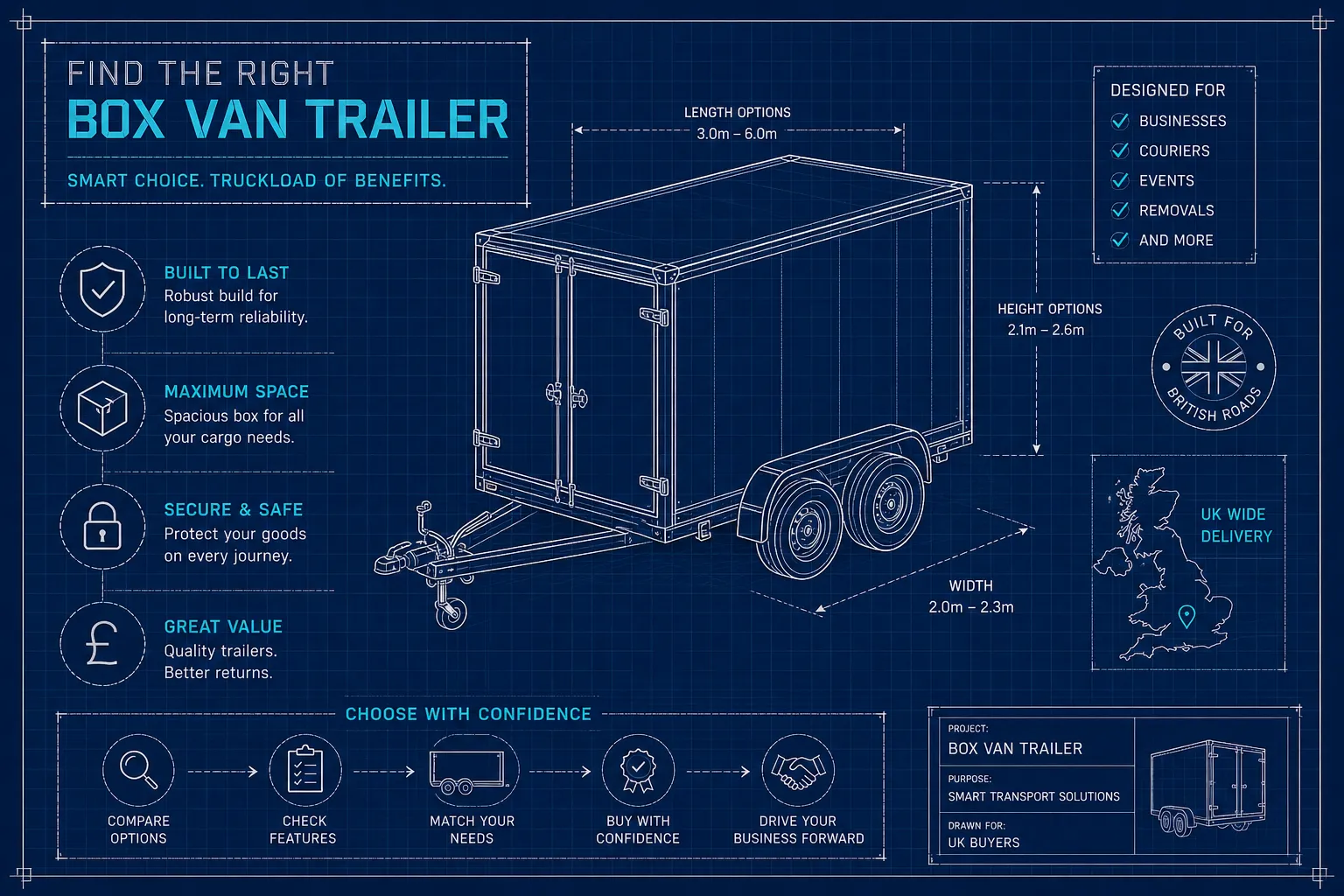
Internal length, width, and height vary more than buyers expect across similar-looking models, even within the same brand. Take the Ifor Williams BV105 and BV126 as a practical example: the BV105 offers 3.0 m of internal length and 1.83 m of headroom, while the BV126 extends to 3.6 m in length with 2.14 m of headroom. That difference matters enormously if you are loading tall equipment or working from inside the trailer. Always ask the dealer for internal specs, because advertised dimensions on many listings refer to external measurements.
Payload, GVW and axle configuration
Payload is the usable load capacity: what you get after subtracting the trailer’s unladen weight from its GVW. For the Ifor Williams BV105, that figure sits close to 2,000 kg, which is a serious working capacity for a single-axle trailer. Single-axle models typically carry less than twin-axle builds and handle differently under load, which affects tyre wear, braking distance, and overall stability. Getting the GVW right from the start is not just about legality; it directly affects how the trailer performs and how long it lasts.
Coupling type and road legality
Many enclosed cargo trailers in the UK use a 50 mm ball coupling, though you should always check the model specification before assuming compatibility with your tow bar. EC type approval is the baseline quality and safety certification for any trailer sold new in the UK; if a dealer cannot confirm it, that is a serious red flag. EC type approval should be your minimum expectation from any verified source.
Where to find box van trailers for sale in the UK: new prices by size
Price ranges shift depending on size, brand, and whether you are buying new or used. Having a realistic figure in mind before you speak to any dealer stops you from overpaying or, equally, from undershooting on quality and inheriting problems.
New box van trailers for sale: a current price guide
Entry-level single-axle models from brands such as Tickner and smaller Debon units typically sit between £2,200 and £3,000 including VAT. A 10×5 box trailer from a mainstream brand such as Blueline generally falls in the £4,800 to £6,240 inc. VAT range, while 12×6 models start around £6,180 inc. VAT and rise from there. Premium, higher-specification models such as the Debon Roadster range can reach up to £9,400 inc. VAT. Most dealer prices are quoted excluding VAT, so add 20% when comparing to ensure you are working with like-for-like figures. Ifor Williams sits at the trusted, durable end of the market; Tickner covers the lightweight budget end, suited to lighter, less demanding use.
Used and second-hand market pricing
The used market for enclosed cargo trailers can offer genuine value, but price alone tells you nothing meaningful about condition. A used twin-axle model listed at £2,500 could be a sound buy or a significant liability, depending on its brake condition, chassis corrosion, and service history. The inspection checklist later in this guide covers the specifics, but the core point is this: a private listing price is only attractive if the trailer does not need £800 in remedial work before it is safe to use on the road.
Hidden costs buyers regularly miss
Delivery charges, servicing, and insurance are costs that rarely appear in a listing price but add up quickly. Commercial trailer insurance in the UK is priced by trailer value, intended use, and storage risk. Annual maintenance, including tyre checks, brake inspections, and hub bearing services, is a recurring cost that buyers consistently underestimate when working out their total budget. Factor these in before you fix a ceiling on what you are willing to spend on the trailer itself. For practical advice on routine upkeep and preventing major repairs, consult a straightforward maintenance guide that covers dry van trailers and essential servicing steps: how to properly maintain your dry van trailer to prevent major repairs.
UK towing rules and licence requirements you cannot ignore
Buying an enclosed cargo trailer that exceeds your legal towing entitlement is not simply a paperwork inconvenience. It is a road safety issue, an insurance issue, and a legal liability. Understanding the rules before you buy prevents an expensive and dangerous mistake.
The 1997 licence rule and what it means for trailer GVW
Drivers who passed their car test on or after 1 January 1997 are limited to a combined vehicle and trailer MAM of 3,500 kg on a standard category B licence. This means the trailer’s GVW must be considered alongside your vehicle’s own weight, not evaluated in isolation. Drivers who passed before that date generally retain a higher entitlement, allowing combined vehicle and trailer combinations up to 8,250 kg MAM. For most people buying a box van trailer for domestic or trade use, the post-1997 rule covers the majority of available models, but it does exclude the largest twin-axle builds. If you are unsure of your entitlement, check the categories on the back of your photocard licence before you start shortlisting trailers by weight. For a concise overview of how the rules apply in practice, see this guide to UK towing laws.
Vehicle towing limits vs. trailer GVW
Your licence category is only half the picture. Your vehicle’s own manufacturer-specified towing limit and gross train weight (GTW) must also accommodate the loaded trailer. A car rated to tow 1,500 kg cannot legally or safely pull a 2,000 kg GVW trailer, regardless of what your licence permits. Always check the vehicle’s handbook and towing plate, not just your licence category. As a general stability guideline, many towing specialists recommend keeping the laden trailer weight below the towing vehicle’s kerbside weight; always cross-reference this against your manufacturer’s stated limits.
Braked vs. unbraked: the 750 kg threshold
Any trailer with a GVW over 750 kg must have its own braking system under UK road law. The vast majority of box van trailers sit well above that threshold, so buying a braked trailer is standard for any serious work use. An unbraked trailer also cannot exceed half the towing vehicle’s kerbside weight in practice, which severely limits its working load. For tradespeople and small businesses, a braked trailer is not optional; it is the baseline for safe and legal operation. For further explanation on the practical differences between braked and unbraked trailers, consult this clear guide on the difference between a braked and unbraked trailer.
Mistakes that cost buyers time and money
These are the errors that consistently send buyers back to the start. Recognising them in advance saves you wasted viewings, deposit disputes, and post-purchase repair bills.
Prioritising price before confirming compatibility
The most common mistake is shortlisting box van trailers for sale on price alone, then discovering the GVW exceeds the tow car’s limit or the internal dimensions do not suit the intended load. Starting with a clear spec requirement, including minimum internal length, required payload, and your vehicle’s towing capacity, prevents this entirely. Write your requirements down before you open a single listing.
Skipping the tow vehicle compatibility check
Many buyers assume their car “can handle it” without checking the towing plate or handbook. Your vehicle’s kerbside weight, any applicable stability guidance, and the GTW limit are three separate checks, and missing any one of them creates a combination that is either illegal, unstable, or both. This is not an area where assumptions are acceptable.
Trusting unverified listings without an inspection checklist
Classified listings frequently omit GVW, year of manufacture, and service history. On used units, the common problem areas are chassis corrosion, worn brake shoes, damaged door seals, soft spots in the floor, and faults in the lighting board. Buyers who skip a pre-purchase inspection regularly inherit repair costs that eliminate any apparent saving on the purchase price. When those costs include brake work and corrosion treatment, the bill often exceeds £800 before the trailer is roadworthy. A verified dealer with documented stock history is often better value than a private listing with a lower headline price, particularly once potential remedial costs are taken into account. The inspection checklist later in this guide covers the specifics, and it helps to follow a structured trailer inspection checklist when you view a used unit.
A smarter way to find verified box van trailers for sale in the UK
Scrolling through classified sites for box van trailers for sale is time-consuming and inconsistent. The listings vary wildly in quality and accuracy. Sellers list what they have; buyers must sift through unsuitable sizes, missing specs, and sellers who do not respond. There is no filter for your tow vehicle, your intended use, or your actual budget. You end up spending hours narrowing a shortlist that should take minutes.
Why classifieds fall short for trailer buyers
Classifieds are built for volume, not for match quality. The platform has no interest in whether the trailer suits your specific requirements; it simply connects you with a listing. That means you carry all the risk: incomplete specs, unverified sellers, and no recourse if the condition on collection differs from what was advertised. For a purchase that will be towed on public roads and used for regular work, that level of risk is unnecessary.
How RightFit Trailers connects you to verified dealers without the guesswork
RightFit Trailers is a UK-based trailer matching platform built for buyers who want guidance alongside listings. Instead of scrolling, you submit your use case and budget, and the platform connects you directly with dealers who stock box van trailers that fit your requirements. Dealers in the RightFit network are assessed for reliability and compliance before being listed, reducing the risk of surprises at the point of collection. The platform covers enclosed cargo trailers alongside a full range of trailer categories across the UK, from livestock and horse boxes to flatbeds and catering trailers.
Free budget evaluation and the Perfect Match Guarantee
RightFit Trailers offers a free budget evaluation that gives you a clear picture of what your money can realistically buy in the current UK market, before you contact a single dealer. Combined with the Perfect Match Guarantee, buyers gain greater confidence in their final choice than any classified listing can provide. If you are ready to buy and do not want to waste weekends on dead-end viewings, this is a more efficient and lower-risk route to the right trailer.
Making a confident purchase
The framework for buying a box van trailer in the UK is straightforward when you approach it in the right order. Start with specs and compatibility: internal dimensions, payload, and GVW relative to your vehicle’s towing limit. Understand the real price range for your size and budget, including the 20% VAT that many listings omit. Confirm your UK towing entitlement and your vehicle’s capacity before you shortlist anything.
Then avoid the classic mistakes: do not prioritise price before confirming compatibility, do not skip the tow vehicle check, and do not trust an unverified private listing without a thorough inspection. Box van trailers for sale across the UK market vary enormously in quality, specification, and long-term value. The difference between a smart purchase and a costly one almost always comes down to knowing what to ask before you commit. Use the free budget evaluation at RightFit Trailers to anchor your search, connect with assessed dealers, and buy with confidence rather than guesswork.