
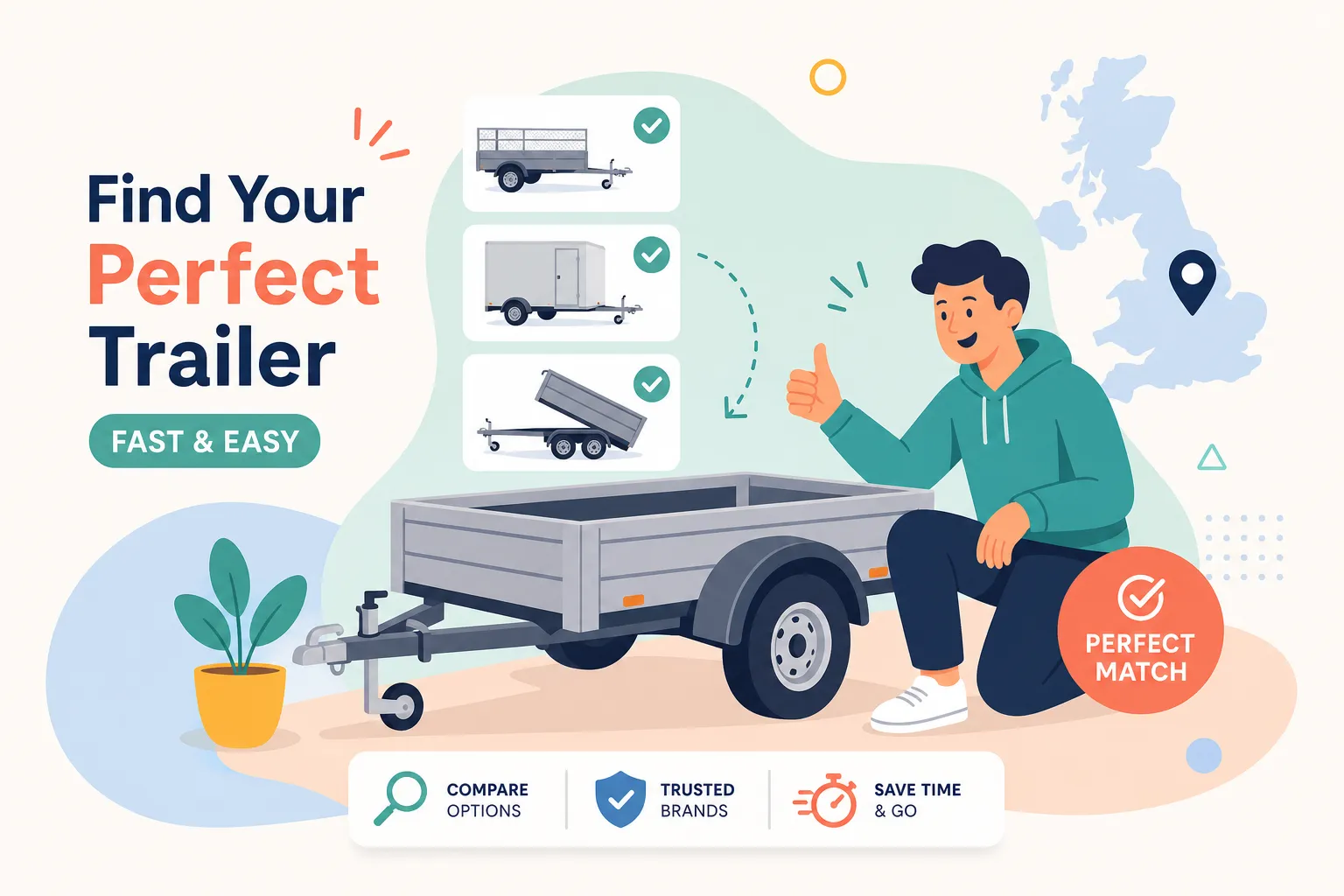
Most trailer buyers follow the same pattern: open a classified site, type in a rough description, and spend the next hour scrolling through listings that are either the wrong size, the wrong type, or technically incompatible with their vehicle. By the time something promising appears, there’s no easy way to confirm whether the car can legally tow it, the handbook may be long gone, and the listing offers no compatibility filter. This gap between what’s listed and what a buyer can actually use is precisely why structured trailer matching has become a genuine need rather than a luxury.
RightFit Trailers was built to address this problem. Rather than adding more listings to an already crowded market, the platform acts as an independent guidance layer, pairing your vehicle specifications, intended use, and budget with compatible trailers before you speak to a single dealer. By the end of this article, you’ll understand the four weight figures that govern UK towing law, know how to run a compatibility check yourself, and have a clear path to finding the right trailer without wading through unsuitable options.
Why trailer classifieds leave most buyers going in circles
UK classified sites carry thousands of trailer listings, yet many lack any meaningful compatibility filter. There’s no mechanism that tells you whether the trailer on screen is legally towable with your car, appropriate for your intended use, or sized correctly for the job. Buyers are left to make those judgements independently, usually without the technical knowledge to do so confidently.
The compatibility gap that generic listings can’t fill
A classified ad typically tells you the price, the dimensions, and sometimes the MAM. What it doesn’t tell you is whether your car’s kerb weight, braked towing limit, or Gross Train Weight allows for the combination. Without those checks, you’re shopping blind. Two trailers that look identical in a photograph can have very different weight profiles depending on axle configuration, body material, and coupling type, and that difference determines whether the match is legal or not.
The real cost of buying the wrong trailer
A trailer that exceeds your vehicle’s towing limit is a roadside check waiting to happen. Beyond the fine, it can void your insurance and create a genuine safety hazard for other road users. Reselling a mismatched trailer quickly almost always means taking a loss. Outcomes like these aren’t unusual; they’re a foreseeable consequence of buying without a structured compatibility check. That’s the reason personalised trailer matching UK buyers need has moved from niche service to genuine necessity.
Trailer matching UK: weight figures explained
There are four numbers that govern every UK towing decision. Once you understand what each one measures and where to find it, the whole process becomes considerably more straightforward.
Kerb weight, towing limit, and the 85% guidance
Kerb weight is your vehicle’s ready-to-drive mass with a full fuel tank and essential fluids, but without passengers or cargo. Your manufacturer-set towing limit is the maximum weight your vehicle is permitted to tow for a braked trailer. The 85% rule, a widely used industry benchmark cited in towing guidance from organisations such as the Caravan and Motorhome Club, states that a trailer’s laden weight should ideally not exceed 85% of the tow car’s kerb weight. This is stability guidance aimed particularly at novice towers, not a UK legal requirement. Experienced drivers may operate at higher ratios, but that demands good judgement and a well-matched outfit.
Gross Train Weight: the combined ceiling
Gross Train Weight (GTW) is the maximum combined mass of your fully loaded vehicle and your fully loaded trailer, shown on the VIN plate under the bonnet or on the driver’s door pillar. Your towing capacity equals GTW minus your vehicle’s gross vehicle weight. Adding more payload to your tow vehicle reduces the weight available for the trailer before you hit the GTW ceiling. If your VIN plate shows no train weight figure, or shows zero, your vehicle is not approved for towing.
Noseweight: the figure most buyers overlook
Noseweight is the downward force the trailer coupling places on the tow ball. Both your vehicle manufacturer and your towbar manufacturer set their own noseweight limits, and the legal maximum is the lower of the two figures. For most single-axle and twin-axle UK trailers, typical noseweight ranges sit between 50 and 100 kg, but exceeding the limit destabilises the combination and may invalidate compliance with towing guidance. To measure it accurately, use a noseweight gauge under the loaded coupling, aiming for roughly 5 to 7% of the trailer’s fully laden weight, provided that stays within your confirmed towbar load rating. If you need a simple tool to check acceptable coupling loads, try an online noseweight calculator to confirm your figures.
Braked or unbraked: the rule that catches buyers off guard
This distinction is where many first-time buyers come unstuck. The UK has a specific legal threshold that determines which trailer type is required, and getting it wrong is a roadworthiness failure, not a paperwork oversight. For a clear overview of the legal thresholds that apply to towing in Britain, see a concise summary of UK towing laws explained.
What the 750 kg unbraked rule means in practice
An unbraked trailer must not exceed 750 kg MAM, and it must also not exceed half of your towing vehicle’s kerb weight, whichever figure is lower applies. Take a practical example: a car with a kerb weight of 1,400 kg has a half-kerb-weight figure of 700 kg. Even though the legal ceiling for unbraked trailers is 750 kg, that driver’s effective limit drops to 700 kg. Many buyers assume the 750 kg figure is universal. It isn’t.
When a braked trailer becomes the only legal option
Once a trailer’s MAM exceeds 750 kg, or exceeds half the vehicle’s kerb weight, it must have its own braking system. The braked trailer’s laden weight must then stay within the vehicle manufacturer’s stated braked towing limit. Always check the trailer’s plated MAM against both thresholds before assuming an unbraked option is suitable. The plated MAM is found on the trailer’s identification plate. If there’s no plate, treat the weight as unknown and verify before towing.
How to run a trailer matching UK compatibility check
With the key figures understood, running a compatibility check is a ten-minute task using information that’s already available to you.
The four numbers to gather before you compare
You need kerb weight and towing limit from your vehicle handbook or the manufacturer’s website, GTW from the VIN plate, and noseweight limit from the towbar documentation. The trailer’s plated MAM comes from its identification plate. One important note: the V5C logbook may include kerb weight under field G (Mass in Service), but it doesn’t reliably list towing figures. The handbook and VIN plate are the sources to trust. Once you have all four numbers, the compatibility check becomes a straightforward series of comparisons against the trailer’s own plated figures.
UK tools that run the maths for you
Several UK tools can speed up the initial sense-check. RoamWorthy accepts a registration number and returns kerb weight, maximum braked towing capacity, and GTW from vehicle specification databases. The NCC’s TowCheck generates a compatibility report for car and caravan combinations, including GTW and brake weight with a traffic-light result. TowCar.info allows you to compare a specific car and caravan for stability, hill-start performance, and legal fit. For guidance on how to work out towing capacity in practical terms, the RAC’s towing capacity guide is a useful reference. These tools work well for narrowing down options, but they’re most useful once you already know what trailer type and approximate size you’re targeting, and none of them replace a full towing capacity calculator UK buyers should apply to their specific vehicle and load. For background reading on purchasing and preparation, see our Trailer Buying Guide Archives, Right Fit Trailers.
What your driving licence actually allows
Since 16 December 2021, drivers who passed their Category B car test on or after 1 January 1997 can tow trailers up to 3,500 kg MAM without needing a separate B+E towing test. Drivers who passed before that date typically hold a broader entitlement covering combinations up to 8,250 kg MAM. For trailers above 3,500 kg MAM, a higher licence category such as C1+E is required regardless of when you passed. Your licence entitlement sets a ceiling, but it doesn’t override your vehicle’s own towing or GTW limits. Both must be satisfied simultaneously. If you’re unsure which test or entitlement applies to your situation, read practical guidance on the B+E trailer licence and the licence requirements for towing a trailer.
Why personalised matching beats going it alone
Knowing your GTW and kerb weight is a solid start, but translating those figures into a verified, correctly sized trailer recommendation for your specific use case is where most buyers still lose time. A structured approach to trailer matching in the UK closes that gap considerably.
What a genuine trailer match actually looks like
A search result returns trailers that fit a keyword. A match returns trailers that fit your vehicle’s weight figures, your intended use, your budget, and your location. Consider two buyers using the same search term. A smallholder with a 1,800 kg kerb-weight estate car, a 1,500 kg braked towing limit, and four sheep to transport has entirely different requirements from a tradesperson looking for an enclosed box van trailer for tools and equipment. Generic search returns both. A personalised match separates them from the start, saving both buyers from wasted enquiries and unsuitable viewings.
How RightFit Trailers removes the guesswork
RightFit Trailers is built around exactly this principle. Rather than listing thousands of trailers and leaving buyers to filter manually, the platform offers a free budget evaluation and use-case-specific trailer recommendations across nine-plus categories: livestock, horse box, box van, flatbed, car transporter, tilt bed, camping, general purpose, and catering trailers. The platform’s matching process is designed to pair your vehicle specifications and intended use with compatible options before you commit to a single enquiry. Dealer listings go through a verification process, which aims to reduce the uncertainty associated with anonymous classified platforms. It’s the structured alternative to compatibility-blind browsing, replacing hours of unsuitable scrolling with a focused, pressure-free recommendation. If you want to see the kinds of trailers matched to specific uses, have a look at our guide to Trailers for Sale in the UK: Which Type Do You Need?.
Start your search the smarter way
The four figures at the heart of trailer matching UK buyers rely on are kerb weight, towing limit, Gross Train Weight, and noseweight. Once you know those numbers and where to find them, the braked versus unbraked decision follows directly. The licence rules, simplified significantly by the 2021 changes, are equally manageable once you know your test date and your trailer’s MAM.
Running these checks independently is entirely possible using the tools and sources covered above. Matching a trailer to a specific use case, a verified seller, and a realistic budget benefits from a structured process rather than an open-ended search. That’s the gap RightFit Trailers fills: not more listings, but better guidance before you commit to a single phone call.
Use the weight figures you’ve gathered here to start your trailer matching UK compatibility check with Find the Right Trailer in the UK | Expert Trailer Matching Service. The right trailer, matched to your vehicle and your load, is a shorter search away than most buyers expect.