
Finding a trailer for sale in the UK for the first time can feel overwhelming. Many buyers open a classifieds site, scroll through dozens of listings, and quickly discover that prices vary widely, descriptions are vague, and a significant number of the trailers on offer simply won’t work with their tow car. That confusion is common, but it isn’t inevitable. It’s what happens when you browse before you’ve done the groundwork.
The smarter approach is to lock in your budget and use case before you look at a single listing. RightFit Trailers offers a free budget evaluation that takes your specific requirements and price range, then matches you with appropriate trailer types and UK dealers. Running that evaluation takes minutes and immediately narrows the field to options that are realistic for your situation, think of it as setting your filters before the search begins, rather than halfway through.
This guide covers everything that follows: current price ranges across common trailer types, the honest trade-offs between buying new and used, where to find reputable listings, the right questions to ask dealers and private sellers, how to inspect a used trailer thoroughly, and the towing legality checks that catch first-timers out more than anything else.
Fix your budget before you browse a single listing
What common trailer types cost in the UK right now
UK trailer prices vary considerably by type, and knowing the realistic ranges before you start searching stops you wasting time on viewings you can’t afford. Small utility trailers sit roughly between £800 and £2,500 new, with used examples available from around £300 upwards. Box trailers run from approximately £1,200 to £5,000 new, and £500 to £3,000 used. Car transporter and flatbed trailers cover a wider band, typically £2,500 to £9,000 new and £1,500 to £6,000 for well-maintained used stock. Horse trailers are the most expensive category, with new prices ranging from £6,000 to over £20,000 and used examples from around £3,000 to £12,000 depending on age, specification, and condition. These figures reflect current market estimates based on active UK listings and dealer pricing in 2026. For more detailed guidance specific to horse trailers see the Horse trailer buying guide: the UK buyer’s checklist.
Used prices fluctuate more than new prices do, particularly at the top end of the horse trailer and car transporter markets. A lightly used three-year-old trailer can look tempting at a significant discount, but condition, service history, and legal compliance determine whether that price is genuinely good value or an expensive problem waiting to happen.
How a free budget evaluation removes the guesswork
Browsing without a clear budget anchor leads directly to wasted viewings, frustrating negotiation dead-ends, and the risk of stretching for a trailer that doesn’t actually suit your needs. RightFit Trailers’ free budget evaluation cuts through that noise: you describe your use case and price ceiling, and the tool returns matched trailer types alongside relevant dealer listings. There’s no sales pressure and no obligation.
Knowing your ceiling also tends to strengthen your position at the negotiating table. A buyer who can state clearly what they’re willing to spend, and why, will often be taken more seriously by dealers and private sellers than one who appears to be guessing. That preparation can pay off in both money saved and time.
New vs used trailers: what the price gap actually means for you
Why buying new suits certain buyers
New trailers come with manufacturer warranties, full documentation, type-approved equipment, and no unknown history. For buyers who depend on their trailer to earn a living, tradespeople, livestock handlers, and vehicle transporters, for example, that reliability has direct financial value. A trailer that fails on a working day costs more than the money spent avoiding a used risk. New stock also tends to include the most current safety features and build standards, which is worth considering for anyone transporting animals or vehicles of significant value.
The premium over used can be substantial, especially for horse trailers and car transporters. For buyers with low-frequency towing needs, that gap may be difficult to justify. For high-use commercial applications, however, buying new often makes more financial sense over a three-to-five year horizon than the upfront saving on a used alternative might suggest.
When a secondhand trailer is the smarter choice
A well-maintained used box trailer or utility trailer can offer most of the functionality of a new one at roughly 40 to 60 per cent of the cost, based on a comparison of current new and used listings across major UK platforms. The used trailer market in 2026 shows more supply than demand in several categories, which gives informed buyers genuine negotiating room, a favourable environment to be buying in, provided you approach it with the right information.
How thoroughly you conduct the inspection and documentation checks described later in this article is what separates a good used purchase from an expensive mistake. Buy well, and a secondhand trailer can serve you reliably for years. Buy poorly, and the saving disappears quickly into repair bills. The next three sections tell you how to buy well.
Where to find trailers for sale in the UK (and what to watch out for)
Online marketplaces and classified sites worth checking
eBay UK remains the broadest general search channel, offering both auction and fixed-price listings across every trailer category. Gumtree and Freeads are the main classifieds options for local private-sale listings, often at lower prices but with minimal seller accountability. Specialist dealer websites offer warranty-backed stock with a traceable seller behind every listing, though prices are typically less negotiable than in the private market. If you’re comparing used trailers for sale across multiple sources, cross-referencing secondhand trailer listings can be time-consuming without a dedicated tool. For an overview of the major UK online marketplaces you might compare when searching for trailers see this guide to the best online marketplaces in the UK.
RightFit Trailers aggregates UK dealer and manufacturer listings across nine trailer categories, removing the need to cross-reference multiple sites. Rather than directing you to a single dealer’s catalogue, the platform lets you compare matched options across the market before you commit to a viewing, independently, and without being steered towards any particular seller.
Why the listing source matters as much as the listing itself
A trailer listed by a verified UK dealer carries a level of accountability that an anonymous classified post does not. If something is misrepresented, there’s a traceable business to go back to. Private seller listings on open platforms are where the majority of trailer purchase problems occur, ranging from undisclosed damage to outright fraud. That doesn’t mean you should avoid the private market entirely; it means you go in knowing the risks and with the inspection and verification steps ready to apply. The next two sections cover exactly that.
Questions to ask every dealer and private seller before you agree to view
What to ask a trailer dealer
These are the questions that quickly separate professional dealers from those who don’t know their stock. Ask what warranty is included and exactly what it covers. Ask whether the trailer is type-approved and meets current UK regulations. Request the original manufacturer documentation and any available service history. Confirm the coupling type and payload rating are appropriate for your intended use. Ask whether the dealer offers a part-exchange or has any take-back policy if the trailer turns out to be unsuitable. A dealer who answers these questions clearly and promptly is one worth continuing the conversation with.
What to ask a private seller
Start with the basics: how long have you owned it, and why are you selling? Ask to see proof of ownership and any original purchase documentation. Find out whether the trailer has been repaired, repainted, or structurally modified since it was manufactured. Confirm whether they’ll allow an independent inspection before any payment is made.
The evasion test is simple and reliable: a genuine seller answers these questions directly. A seller who deflects, gives vague responses, rushes the conversation, or refuses a proper in-person viewing is signalling a problem regardless of how attractive the listing looks. Trust that signal and move on.
How to inspect a trailer for sale before you hand over any money
The physical checks that reveal a trailer’s real condition
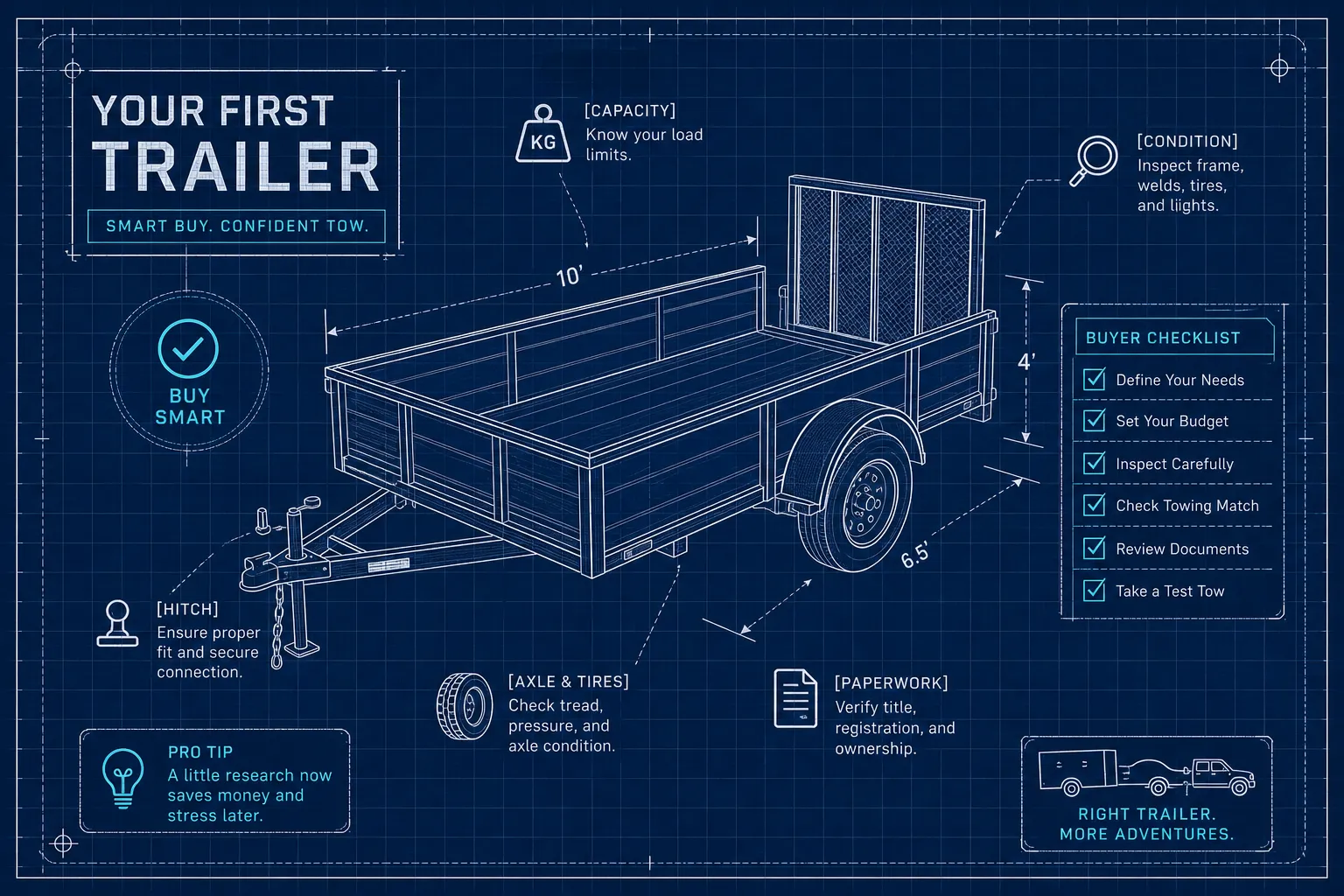
Work through the trailer systematically. Start with the chassis: examine the main frame rails and crossmembers for cracks, bent sections, rust-through, and poorly executed weld repairs. Surface rust is normal on an older trailer; flaking rust, holes, or structurally weakened sections are not. Check the axles for bends, deformation, and scrape marks, then look at the tyre wear pattern. Uneven wear across an axle often indicates misalignment that the seller may not have disclosed. Spin the wheels by hand if you can and listen for grinding or bearing play. For a practical, illustrated step-by-step inspection checklist see the guide from how to inspect a used trailer before you buy it locally.
Test every light on the trailer, running lights, brake lights, indicators, and hazard flashers. Inspect the wiring plug for corroded pins, frayed insulation, and loose connections. Then move to the hitch coupler and drawbar: check for cracks around welds, any distortion in the neck, and confirm the locking mechanism engages cleanly and securely. On braked trailers over 750kg, confirm the brake system responds correctly before you consider signing anything.
Paperwork, VINs, and the scam red flags to know
Verify the VIN plate is present, legible, and matches any documentation provided. Check that the serial number hasn’t been altered or removed, as this is one of the clearest indicators of a stolen or encumbered asset being moved through the private market. Ask for any repair or modification records, and treat missing paperwork as a serious concern rather than a minor inconvenience. If you’re buying a horse trailer, the animal welfare and conversion history checks are particularly important, see the more detailed horse checklist in Buying a Horse Trailer: 14 Checks Before You Commit.
The red flags specific to classified ad purchases are consistent: prices well below market value, sellers who avoid in-person viewings or push for a quick decision, requests to pay by bank transfer before inspection, and listings with very few photos or descriptions that don’t match the trailer category. If any of these appear, they’re not coincidences. Walk away and find a better listing through a verified source.
Towing rules and licence checks for trailers for sale
Matching your driving licence to the trailer you want
This is the area first-time buyers most consistently overlook, and the consequences of getting it wrong range from a fine to a serious road incident. UK drivers who passed their car test after 1 January 1997 hold a standard Category B licence, which limits towing to within the vehicle’s rated capacity as part of a combination that doesn’t exceed 3,500kg MAM. Drivers who passed before that date typically retained broader entitlement, in many cases up to 8,250kg MAM for vehicle-and-trailer combinations. Check the back of your photocard for the category codes listed against your licence before you buy anything. GOV.UK publishes current guidance on towing entitlements if you need to verify your specific situation: towing weight and width limits.
If the trailer you want requires a combination that exceeds your current entitlement, you’ll need a B+E test before you can legally tow it. Using the wrong licence category on the road is not a technicality. It represents an uninsured risk and carries real legal consequences. For straightforward, official advice about driving licences and towing entitlements see driving licence guidance for towing.
Vehicle towing capacity, towbar approval, and trailer weight
Confirm the trailer’s Maximum Authorised Mass (MAM) and expected loaded weight against your vehicle’s published towing limit, which you’ll find in the owner’s handbook or on the vehicle’s VIN plate. If no train weight is listed on the VIN plate, the vehicle should not be used for towing. Standard UK rules also set a maximum trailer width of 2.55 metres and a maximum trailer length of 7 metres for vehicles up to 3,500kg MAM.
Towbars on vehicles first registered after 1 August 1998 must be type-approved for the specific vehicle model. A mismatched or unapproved towbar is not just a legal compliance issue; it’s a genuine safety risk under load. Confirm the approval number on the towbar label and verify it matches your vehicle before you couple anything to it.
The right trailer is out there: buy it on your terms
Buying a trailer for sale in the UK for the first time doesn’t have to be a gamble. The buyers who come away satisfied are the ones who established their budget and use case before they browsed, asked the right questions before agreeing to a viewing, inspected every trailer thoroughly, and confirmed towing legality before any money changed hands. That process isn’t complicated, but it is deliberate.
RightFit Trailers’ free budget evaluation is a practical starting point for narrowing the field. It takes the guesswork out of price ranges and matches your requirements to appropriate trailer types, whether you’re looking at a car trailer for sale, a utility trailer for sale, or something more specialist, see Trailers for Sale in the UK: Which Type Do You Need? for more on choosing the right category.
Work through the steps in sequence, take nothing on trust without verification, and there’s no reason the right trailer for your needs and budget should be difficult to find.