
If you’re browsing general duty trailers for sale in the UK, you’re in good company. They’re one of the most popular trailer types on the market, and it’s easy to see why: straightforward to run, widely available, and priced accessibly enough that buyers from smallholders to tradespeople feel comfortable shortlisting one early. The problem is that “general duty” can mean different things to different buyers, and what sounds like a versatile fit can turn out to be the wrong tool for your specific load.
Buying the wrong trailer type doesn’t just waste money on the purchase. It costs you time when the trailer doesn’t cope with your actual workload, and it costs you again when you sell it on and realise the resale value reflects a trailer that was never quite right. That’s where a tool like RightFit Trailers earns its keep, confirming whether a general duty model genuinely matches your use case, rather than assuming it does because the name sounds broad enough.
By the end of this article, you’ll know the key specs to compare, realistic prices for new and used stock in 2026, what dealers currently hold in inventory, and whether a general duty trailer actually fits your situation or whether a specialist alternative deserves a closer look. The appeal of this trailer type is genuine, but so are its limits.
General duty trailers for sale: what the category actually means
Built for versatility, not a single job
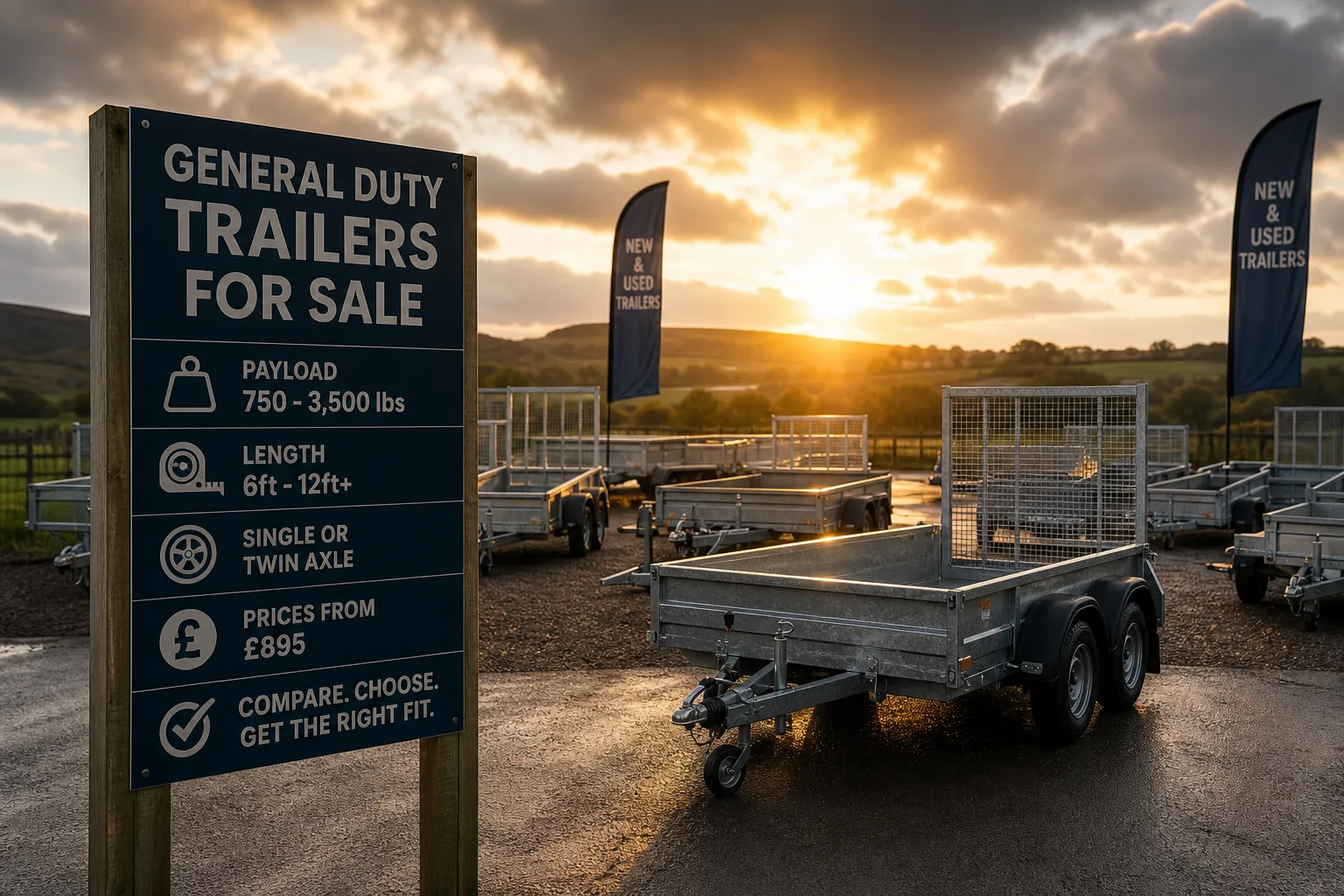
A general duty trailer is designed to carry a wide range of loads rather than being optimised for one task. The typical build is an open or mesh-sided steel frame with a flat bed or low sides, removable panels, and a standard tow ball coupling. There’s no fixed livestock compartment, no enclosed cargo body, and no specialist loading ramp configuration. The Ifor Williams GD range is the natural reference point here because it dominates the UK market, most general duty trailers, whether from Ifor Williams or competitors like Ram, share this same design logic: strong, simple, adaptable.
That simplicity is the point. A general duty trailer isn’t cutting corners; it’s deliberately built without the fixed features that would make it excellent at one thing but awkward at everything else. The gross vehicle weight, payload, and axle configuration do the heavy lifting in terms of specification, not specialist bodywork.
Where specialist trailers outperform them
Being honest about the trade-offs matters here. A general duty trailer handles garden waste, building materials, plant equipment, fencing supplies, and general farm haulage very well. It does not protect livestock, secure a vehicle safely on ramps, or keep tools dry the way a box van trailer does. These are structural limitations, not manufacturer oversights.
If your primary use case involves transporting horses or cattle, vehicle transport trailers will be better configured, moving a car safely needs wheel tie-down points and a low loading geometry that a flat-bed trailer simply isn’t configured for, and running a trade business where tools need to stay secure and dry calls for an enclosed body. This isn’t a warning; it’s a practical filter. If any of those scenarios describe your core need, a general duty trailer is the wrong starting point.
Who a general duty trailer genuinely suits
The buyers who get the most from this type
Think about the landscaper who hauls green waste on Monday, aggregate bags on Wednesday, and borrowed garden equipment at the weekend. Or the smallholder who needs to move bales, fencing posts, and the occasional pallet without investing in separate trailers for each job. Then there’s the hobbyist who needs a trailer a few times a month for genuinely different tasks rather than one dedicated purpose. For all three, the general duty design is a genuine strength: lower purchase price, fewer components to service, and a flat bed that accommodates almost any shape of load with the right securing points.
The simplicity that looks like a limitation on paper is actually what makes this trailer type last well in mixed-use situations. Fewer specialist mechanisms mean fewer things to go wrong, and the open design makes loading and unloading faster for loose or bulky materials.
The moment to reconsider your choice
Where buyers run into trouble is when they assume a general duty trailer will handle a specialist task adequately. Transporting horses requires proper ventilation, secure partitions, and animal-safe construction that a general duty build doesn’t include. Moving a classic car needs wheel tie-down points and a low loading geometry that a flat-bed trailer simply isn’t configured for. Running tools on a trade site in wet weather in an open trailer means damaged equipment and unhappy customers.
If your use case falls into that grey area, where a general duty trailer covers 80% of what you need but leaves a clear gap for the rest, that’s exactly the kind of scenario where RightFit Trailers’ use-case matching logic is worth five minutes of your time before you buy. A quick check can save a costly mismatch.
The specs that matter most when comparing models
GVW, payload and axle configuration: what the numbers mean
Gross vehicle weight (GVW) is the maximum legal weight of the loaded trailer. Subtract the trailer’s own empty (tare) weight and you get the payload: the actual load you can legally carry. This relationship is straightforward, but buyers frequently overlook how dramatically axle configuration changes it. The Ifor Williams GD84 is the clearest example: the single-axle version carries around 1,400 kg GVW, while the twin-axle version jumps to 2,700 kg. The bed dimensions look broadly similar; the load capacity is nearly double.
Axle configuration is the most important spec decision you’ll make when choosing a general duty trailer for sale in the UK. Twin-axle models spread the load across four wheels rather than two, improving stability and increasing the legal payload substantially. They also require brakes by law once you exceed 750 kg GVW, which adds a servicing consideration. Your tow vehicle’s capacity must match the trailer’s GVW, exceeding your car’s towing limit is both dangerous and illegal. Check the GOV.UK guidance on towing with a car or your vehicle handbook before you shortlist any model.
Bed dimensions and what loads they realistically fit
The Ifor Williams GD84 offers an internal bed of approximately 8 ft by 4 ft, while the GD105 extends to around 10 ft 2 in long and 5 ft 2 in wide. For comparison, the Ram general-purpose range offers configurations in 8, 10, and 12 ft lengths across 4, 5, and 6 ft widths, a similar spread of choices from another established UK manufacturer. Internal dimensions, not the external footprint, are what matters for load planning.
One practical caution: manufacturers measure dimensions differently. Some quote deck size; others quote internal box dimensions or overall external length. The model name alone tells you very little. Always check the manufacturer’s spec sheet directly, and if you’re viewing a trailer in person, take your own measurements before you commit.
General duty trailers for sale: new vs used in 2026
Current new-trailer prices from UK dealers
A new Ifor Williams GD84 currently lists at around £2,100 from stock at some dealers, with prices from approximately £1,965 excluding VAT at others, rising to around £2,358 including VAT at 20%. The GD105, with its larger bed, carries a higher price in line with the additional capacity. If you’re buying for a trade business, the VAT is reclaimable, which makes the ex-VAT figure the one to focus on when comparing total cost.
Dealers including Blains, J&C Griffiths, and Chandlers currently hold general duty stock available for immediate collection or delivery. Lead times and included accessories (removable sides, spare wheels, coupling accessories) vary between dealers, so contacting at least two before you commit is a straightforward way to negotiate better value and confirm what’s actually in the listed price.
The used market: condition, price ranges and what to watch for
Used general-purpose trailers for sale in the UK span a wide price range. Budget units from older or lesser-known manufacturers can be found from around £1,250, while lightly used, well-maintained examples from premium builders list at £7,000 or more. The mid-market sits roughly in the £2,500 to £6,000 range for trailers in usable, honest condition. These figures reflect listings on specialist sites and vehicle marketplaces, though prices shift regularly with supply and season.
Condition descriptions in used listings are seller-described rather than independently graded. Terms like “good condition” and “little used” carry no standardised meaning. Physical inspection is essential. Key checks include coupling wear, brake function on twin-axle models, floor integrity (particularly on older steel-frame trailers where corrosion can go unnoticed), and whether the trailer carries a valid plate. Used Ifor Williams trailers sold outside the manufacturer’s network come with no warranty, so any repair costs after purchase fall entirely on you. For further reading, see our General Purpose Trailers UK guidance on condition and servicing considerations.
- Inspect the frame and chassis for cracks, welded repairs, and heavy rust
- Check tyres for age, sidewall condition, and uneven wear
- Test lights, indicators, and brake function before leaving the viewing
- Verify the trailer plate is legible and the numbers match the paperwork
Dealers, stock and the after-sales picture
Warranty and servicing: what new buyers can expect
Ifor Williams’ standard warranty covers new trailers for 12 months from delivery against defects in materials and workmanship. Claims go through the authorised dealer rather than directly to the manufacturer, so the dealer relationship matters beyond the initial purchase. After the warranty period, accredited dealer workshops handle routine servicing, brake checks, and parts supply. DIY service kits exist for Ifor Williams trailers, but unapproved modifications or non-genuine parts can affect warranty validity, worth confirming with your dealer before doing your own work.
Where a specific model isn’t held in stock at your preferred dealer, factory lead times can run up to three months, so buyers with an urgent need should prioritise confirming live availability early in the process rather than choosing purely on price.
How to confirm a general duty trailer is truly the right fit
The question buyers often skip
Most buyers go straight to comparing prices without first confirming that a general duty trailer actually matches their most frequent load type, tow vehicle, and storage situation. That’s understandable: prices are easy to compare and dimensions seem objective. But the buyer who hauls building materials five days a week and occasionally needs to move a quad bike ends up compromising on at least one job, and often both. A trailer that handles most jobs adequately may still fall short of the one task you rely on most, and that shortfall rarely shows up until after purchase.
Choosing the right general duty trailer for sale with RightFit Trailers
RightFit Trailers is built specifically to help UK buyers answer this question before they commit. You describe what you’re towing, how often, and with what vehicle, and the platform works through whether a general duty trailer genuinely fits or whether a livestock, flatbed, car transporter, or box van option would serve you better. There’s no pressure and no upsell: RightFit Trailers operates as an independent guidance platform, not a dealership. The Perfect Match Guarantee backs that up, giving buyers confidence that the recommendation is based on their actual needs rather than what’s easiest to sell.
The free budget evaluation is worth using even if you’re fairly confident about your choice. It checks tow car compatibility against your shortlisted model’s GVW and connects you with verified UK dealers who carry the stock you need. Avoiding the most common and expensive buying mistakes is simply a matter of taking a few minutes before you commit.
Making your decision with confidence
General duty trailers for sale in the UK cover a genuine and significant need: versatile, everyday hauling for buyers who want one trailer to handle a range of jobs without specialist complexity. For the right buyer, that’s exactly what they deliver. But they are not a catch-all solution, and treating them as one is how buyers end up unhappy six months after purchase.
The numbers matter: a twin-axle general duty trailer can carry nearly double the payload of a single-axle model at the same bed size. Used units need careful physical inspection because seller-described condition is not independent grading. Dealer stock and lead times vary significantly right now, so confirming live availability before you choose a dealer is a practical step that saves time and disappointment.
Before you commit to any model, use RightFit Trailers’ matching tool to confirm the fit. It takes a few minutes, it’s free, and it’s the most reliable way to know whether a general duty trailer for sale is the right call or whether a specialist option deserves a closer look first.