
Many buyers searching for trailers for sale in the UK encounter the same frustration: listings that give you a photo, a price, and a payload figure, but nothing about whether that trailer suits your load, your tow vehicle, or your driving licence. A wrong purchase wastes money and creates real safety risk every time you hook up and drive away.
That is exactly the problem RightFit Trailers was built to solve. As a free, independent matching platform, it asks about your use case, your tow vehicle, and your budget, then connects you with verified UK dealers who stock the right category for your needs. No scrolling through irrelevant listings. No pressure from sales staff chasing targets.
Use this article as your shortcut. Read which trailer type matches your situation, understand what prices look like in 2026, know what to inspect on a used unit, and understand the towing rules before you commit. That is everything you need to buy correctly the first time.
Trailers for sale: everyday categories most buyers are searching for
Car trailers for sale and tilt-bed vehicle transporters
Car trailers are designed to carry one vehicle on an open deck and are popular with classic car collectors, motorsport enthusiasts, and small vehicle recovery operations. A basic single-axle car trailer handles lighter vehicles well, while a braked tandem-axle tilt-bed is the right choice for heavier or lower cars where a conventional loading ramp creates ground clearance issues. Deck length and payload rating are the two figures that actually matter: confirm the trailer’s rated payload exceeds your car’s kerb weight, with a sensible margin. When browsing car trailers for sale in 2026, UK buyers are typically looking at roughly £1,000 to £4,000+ depending on axle configuration, braking, and deck specification. These are indicative retail ranges based on current dealer listings.
One rule catches buyers out regularly: any trailer with a Maximum Authorised Mass (MAM) over 750kg requires the tow vehicle to have a rated towing capacity that matches or exceeds it. Check your vehicle handbook before selecting a trailer by weight, not after. If you need more detail on what your vehicle can legally tow, consult a comprehensive towing capacity guide to compare vehicle ratings and safe loading practice.
Flatbed and utility trailers for sale
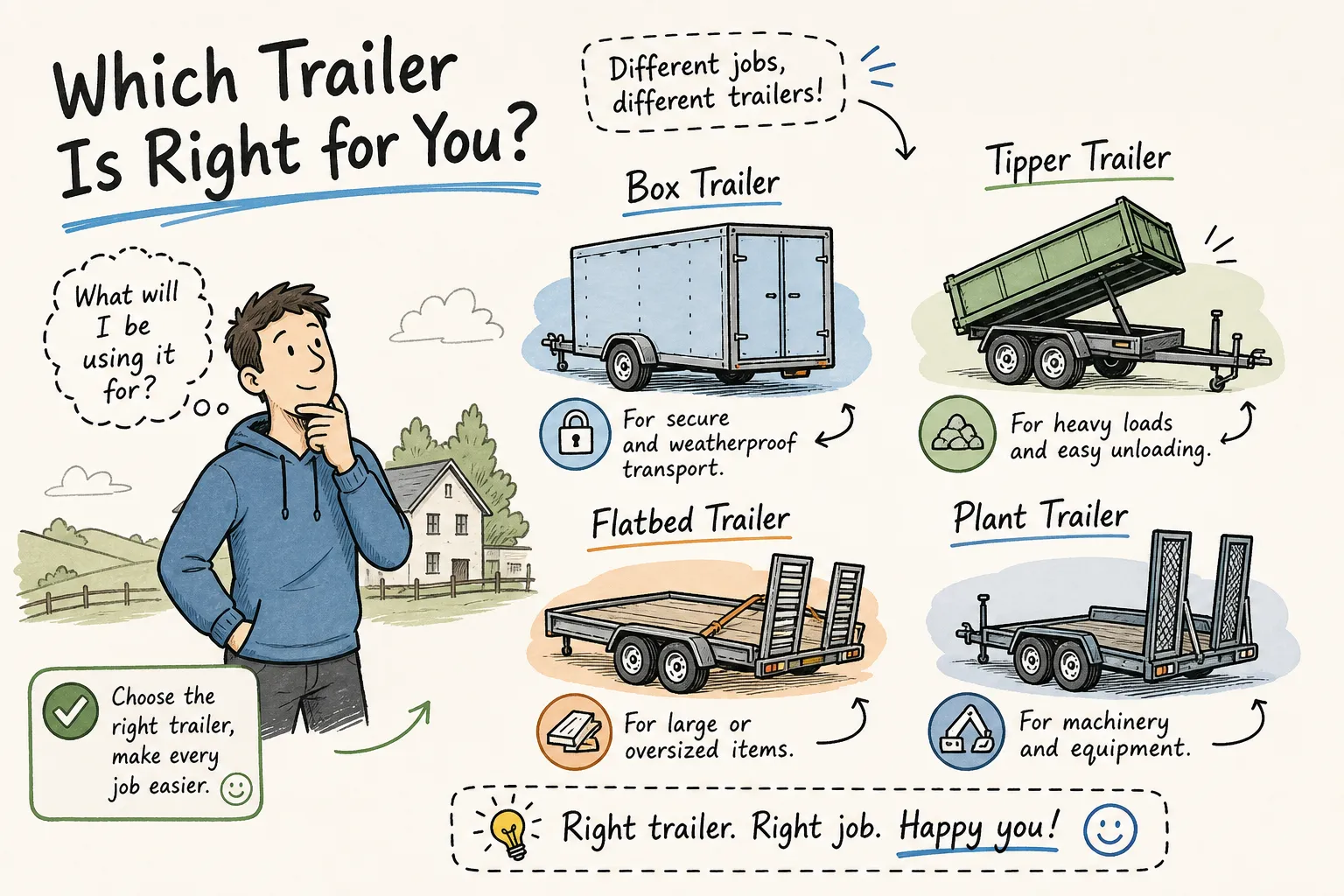
Flatbed trailers are the workhorse of the UK trailer market. Landscapers, builders, and general haulage users rely on them because they are versatile, easy to load, and straightforward to maintain. A basic single-axle utility trailer suits lighter general loads, while a heavy-duty tandem-axle flatbed with a higher GVW handles plant, materials, and commercial volumes. Brands such as Ifor Williams and Indespension appear consistently across dealer stock in this category because they hold their value and parts remain widely available. The 2026 indicative price range for flatbed trailers for sale sits at £1,200 to £6,000+, with specification being the main driver. If your loads are regularly exposed to weather or theft risk, consider an enclosed box trailer instead of an open flatbed.
Enclosed box trailers for tools and cargo
Tradespeople consistently prefer enclosed box trailers over open flatbeds for one straightforward reason: security. An enclosed trailer locks, keeps tools dry, and allows load restraint without the visibility problems of a sheeted flatbed. Box trailers from manufacturers such as Ifor Williams and Nugent are common in dealer and used stock across the UK, and their reputation for build quality means older units retain good resale value. In 2026, new enclosed box trailers range from £1,500 to £7,500+ depending on internal dimensions, door configuration, and build material. These figures are indicative retail estimates. On used stock, inspect the roof and floor for water ingress before agreeing a price. For current Nugent specifications and dealer stock, check authorised Nugent dealers.
Specialist trailers for animals, agriculture, and heavy plant
Livestock trailers and agricultural use
A livestock trailer is fundamentally different from a general-purpose trailer. Ventilation panels, internal partitioning, non-slip flooring, and a proper loading ramp are not optional extras; they are welfare and regulatory requirements for transporting cattle, sheep, or pigs on UK roads. The right size depends on your herd and journey length: a small sheep trailer covering local distances is a very different purchase from a multi-deck cattle trailer for longer hauls. Buyers in this category should verify compliance with the Welfare of Animals (Transport) (England) Order 2006 before purchasing any unit, new or used.
Horse trailers and horse boxes: knowing the difference
This is one of the most common sources of confusion in UK buyer searches. A horse trailer is a towed unit attached to a car or large 4×4. A horse box is a self-propelled lorry or van conversion. They are not interchangeable terms. For most private owners transporting one or two horses, a towed trailer is the more practical and affordable option, provided the tow vehicle has sufficient rated towing capacity to handle the fully laden trailer weight. A typical two-horse trailer loaded with horses, tack, and water can easily reach 2,500kg or more: verify payload before you buy, not after. For horse boxes with a MAM over 3,500kg, an HGV licence is required, confirm the specific threshold applicable to your licence via GOV.UK towing guidance.
Plant and equipment trailers
Groundsworkers, small contractors, and plant-hire businesses need trailers built to carry mini-excavators, ride-on mowers, and heavy equipment safely. That means robust ramps, braked axles, and a GVW rating that genuinely matches the tow vehicle. Plant trailers carry higher price points because the chassis engineering, ramp design, and braking specification are substantially more demanding than on a standard flatbed. Expect to pay £2,500 to £10,000+ for a quality plant trailer in 2026. GVW matching to your tow vehicle is critical; exceeding it is illegal and creates serious instability on the road.
Leisure, camping, and catering trailer options
Camping trailers and touring luggage trailers
Camping trailers range from a basic weatherproof box on wheels through to purpose-built teardrop-style units with sleeping accommodation and integrated storage. For lighter leisure use and weekend trips, a simple camping luggage trailer starts from around £1,000, while specialist units with more features push well above £8,000. These trailers are often a first purchase for buyers who have never towed before, so checking tow car compatibility carefully is essential. Most smaller leisure trailers fall under 750kg MAM, a threshold that generally keeps the licence and towing rules more straightforward for many drivers, though you should always confirm your entitlement via GOV.UK.
Catering and mobile unit trailers
A catering trailer is a distinct product from a box trailer, even though the two can look similar from a distance. A properly specified catering trailer includes food-grade internal surfaces, serving hatches, ventilation, electrical supply provision, and flooring that meets hygiene standards. For buyers setting up a street food or mobile catering business, buying new is generally the right call: a used catering unit requires thorough inspection for compliance history, and cutting corners at the setup stage creates problems with environmental health licensing further down the line.
New vs used trailers: what the price difference actually means
The table below summarises indicative retail ranges for the most common categories of trailers for sale in the UK in 2026. These figures are drawn from current dealer listings and are provided as a guide only; bear in mind that some dealers quote prices inclusive of VAT while others do not, a difference that can represent several hundred pounds on a mid-range purchase.
| Trailer type | Typical 2026 price range (indicative) |
|---|---|
| Car trailer | £1,000, £4,000+ |
| Flatbed / utility | £1,200, £6,000+ |
| Enclosed box trailer | £1,500, £7,500+ |
| Plant trailer | £2,500, £10,000+ |
| Camping trailer | £1,000, £8,000+ |
Used trailers for sale can offer genuine savings, particularly in the flatbed, box, and car trailer categories. Older Ifor Williams and Nugent units are well-regarded in the second-hand market: they hold their value, parts are readily available, and dealers across the UK are familiar with servicing them. The main risks on a second-hand purchase are chassis corrosion from years of outdoor storage, previous commercial use that has stressed the running gear, and missing paperwork that makes verifying the trailer’s history impossible. A used trailer at a low price is only a good deal if it passes the inspection checks covered in the next section. If you’re unsure about inspection scopes, consider arranging a professional pre-purchase inspection for the tow vehicle and trailer to avoid costly surprises.
What to check before you hand over any money
Before you commit, follow a standard trailer inspection checklist to ensure you cover the chassis, running gear, electricals, and paperwork. Use the checklist methodically so you do not miss hidden faults that are expensive or dangerous in service.
Chassis, floor, and body condition
Start underneath and work forward. Check the drawbar, main frame rails, crossmembers, and welds for rust, cracks, repairs, or deformation. Surface rust on a painted frame is common and manageable; deep corrosion that has penetrated through structural sections is a different matter entirely. Galvanised frames age better than painted steel and are worth prioritising on older used stock. Check the floor for soft spots, rot, or water ingress, particularly in enclosed and livestock trailers where condensation accelerates deterioration.
Running gear, brakes, lights, and coupling
Work through the running gear methodically: spin each wheel by hand and listen for rough bearings, check tyre tread depth and look for cracking in the sidewalls, and confirm tyres are not past their age limit. Test the overrun braking mechanism if fitted, and check brake components for wear and corrosion. Test every lighting circuit with the trailer plugged into your tow vehicle, brake lights, indicators, tail lights, and the number plate light all need to function correctly. Inspect the coupling head for cracks, excessive play, and corrosion, and confirm the breakaway cable is present and in good condition.
Paperwork, VIN, and towing licence rules
Match the VIN plate on the trailer to the documents. If the plate is missing, altered, or the numbers do not correspond to the paperwork, walk away. On the licence side, the two rules that matter most are as follows. If you passed your car test before 1 January 1997, you can generally tow a vehicle-and-trailer combination up to 8,250kg MAM. If you passed on or after 1 January 1997, your Category BE entitlement typically covers a trailer up to 3,500kg MAM combined with the tow vehicle, though entitlement rules also changed in 2013, so always verify your specific situation via GOV.UK’s official towing guidance. Regardless of licence, you cannot legally exceed your tow vehicle’s rated towing capacity: check the vehicle handbook before selecting any trailer by weight.
How to find the right trailer without scrolling through hundreds of listings
Generic listing sites show you everything at once: a braked car trailer sits alongside a livestock unit, a catering trailer, and a flatbed, with no guidance on which suits your vehicle or your use case. Without filtering by use case, towing capacity, and GVW, buyers regularly end up enquiring on trailers that are the wrong category, the wrong weight, or from dealers who do not cover their region. That is time wasted at best and an expensive mistake at worst.
RightFit Trailers works differently. Tell the platform what you need to carry, what you tow with, and what you have to spend. It filters to the trailer categories and price ranges that genuinely suit your situation, then connects you with verified UK dealers who stock those options. A Perfect Match Guarantee backs every referral, and the free budget evaluation takes only a few minutes to complete, immediately narrowing your search to options that are actually relevant to your needs.
The direct route from research to the right trailer
The frustration at the start of most trailer searches is not a lack of stock: it is a lack of guidance. There are enough trailers for sale across the UK to suit almost any use case and budget. The challenge is matching the right unit to the right buyer efficiently and safely.
The decision path has four steps:
- Identify your use case and the correct trailer category.
- Set a realistic budget using the 2026 price ranges above as your reference.
- Verify chassis condition, running gear, and paperwork before any money changes hands.
- Confirm your tow vehicle’s rated capacity before committing to any trailer weight.
The fastest way to move from that knowledge to speaking with a verified dealer is the free trailer match tool on RightFit Trailers. Use it before you commit to any listing, and you will avoid the category mismatches, the condition surprises, and the towing limit errors that can turn an exciting purchase into an expensive lesson.