
Choosing the right cargo trailer for tradesmen is one of the most consequential purchasing decisions a working tradesperson will make, yet it rarely gets the attention it deserves. Talk to enough tradespeople and you’ll hear the same story: someone buys a cheap open trailer in a hurry, parks it on a work site overnight, and returns the next morning to find the doors have let in half the night’s rain and the power tools are soaked. Three hundred pounds’ worth of kit needs replacing before the working week has properly started, though that figure varies widely depending on what was left inside. Others buy enclosed but underestimate the payload once racking goes in, and find themselves technically overloaded before a single bag of cement is on board. These aren’t edge cases. They’re the result of treating a trailer purchase like buying a wheelbarrow rather than what it actually is: a piece of working infrastructure that goes everywhere you go, every day.
The wrong cargo trailer for tradesmen costs money twice, once at purchase, and again in lost tools, repairs, or legal complications. Get it right, and a proper tradesman trailer functions as a mobile workshop, a secure store, and a reliable workhorse for years. This guide covers the four things you need to nail: trailer type, key specs, UK legal requirements, and fit-out costs. If you’d rather skip the research phase entirely, RightFit Trailers offers a free, no-pressure matching service that connects you with verified UK dealer options based on your trade, your load, and your tow vehicle.
Choosing a Cargo Trailer for Tradesmen: Enclosed vs Open
The first decision shapes everything else. Enclosed or open determines your security posture, your weatherproofing, how the trailer handles on the road, and ultimately what you can safely carry. Getting this wrong is an expensive mistake, so it’s worth spending five minutes thinking it through properly rather than defaulting to whichever option is cheaper on the day.
Why most tradespeople lean towards enclosed trailers
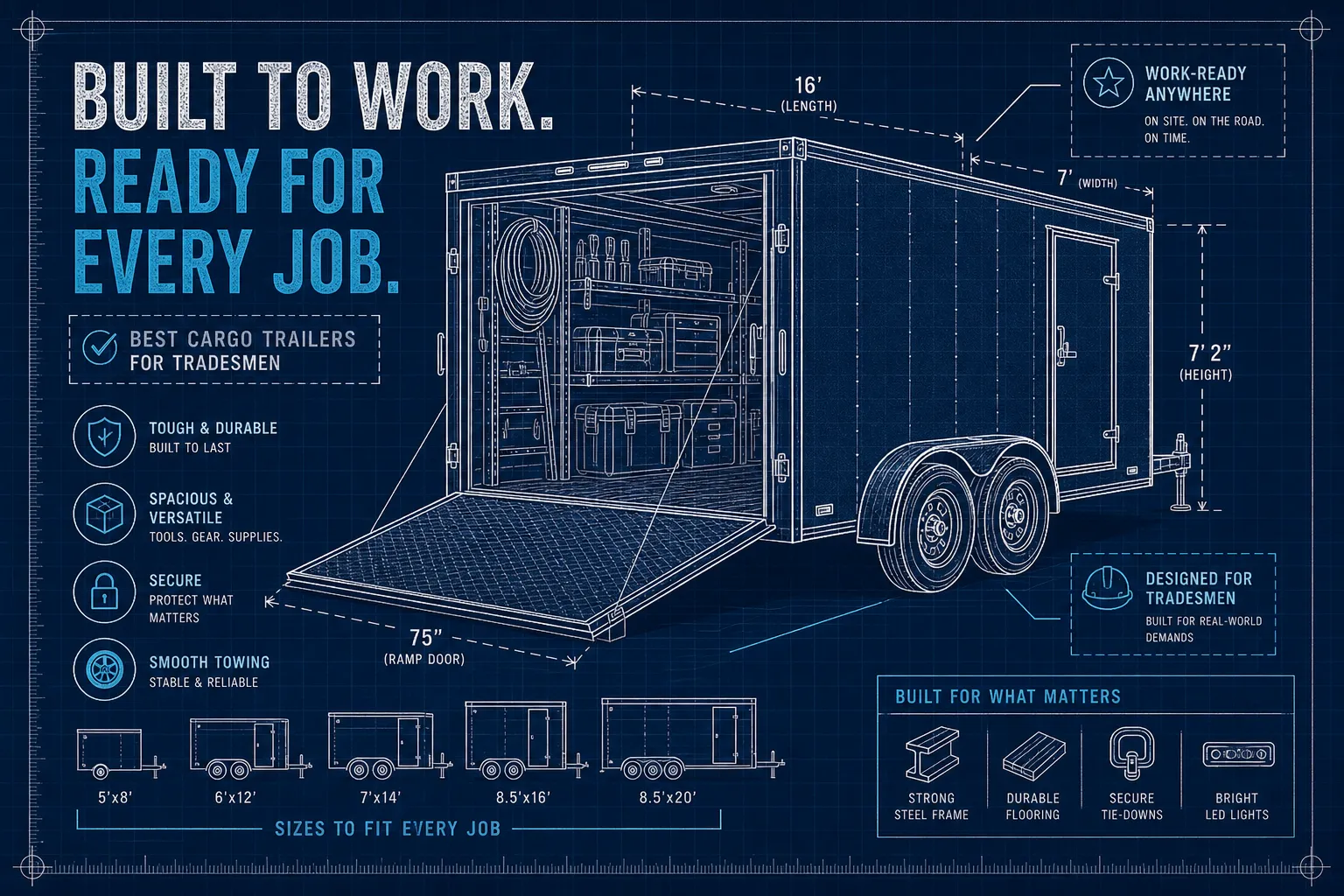
Enclosed box trailers keep tools dry, out of sight, and significantly harder to steal than anything sitting in an open cage. For plumbers, electricians, and joiners carrying a mix of hand tools and power tools, this matters enormously. An enclosed build doesn’t just transport your kit, it becomes a mobile workshop you can work out of on site. Many tradespeople report spending less time packing and unpacking because everything has a fixed home inside. Brands such as Ifor Williams, Debon, and Brian James all offer well-regarded enclosed trailer options in the UK, with varying payload and size configurations to suit different trades. Top enclosed cargo trailer brands can provide a useful comparison when narrowing choices.
When open flatbed or cage trailers make more sense
Some trades genuinely don’t benefit from a box. If you’re a landscaper moving a ride-on mower, a groundworker hauling aggregate, or a builder shifting lengths of timber and sheet material, an enclosed trailer is more hindrance than help. Loading and unloading large, awkward items through a rear door is slow and frustrating. Open flatbed and cage trailers offer full access from any angle and handle bulky loads far more practically. The trade-off is real: your kit is exposed to rain and to anyone who walks past with a pair of hands. For trades where the load itself is large, heavy, and less portable, that’s often an acceptable compromise.
The hybrid option worth knowing about
Box trailers with detachable cage extensions or tilt-and-slide variants occupy useful middle ground for tradespeople whose loads vary significantly week to week. A groundworker who also carries smaller powered equipment, for instance, might find this flexibility worth the extra investment. These multi-configuration builds typically carry a higher price premium than a standard enclosed or open trailer, and the setup is slightly more involved. If your loads are consistent, a simpler single-type trailer is usually the better choice.
Payload, ATM and What Those Numbers Mean on the Job
Payload figures are where tradesman trailer purchases most commonly go wrong. The headline number on a listing looks generous. Then racking goes in, a few power tools are loaded, and the maths stops working. Understanding three terms before you buy will save you from this problem entirely.
Payload for a Cargo Trailer for Tradesmen: ATM and Tare Explained
ATM (aggregate trailer mass) is the maximum the fully loaded trailer is legally allowed to weigh. Tare is the weight of the trailer itself when empty. Payload is what you actually have left to work with: ATM minus tare. A single-axle enclosed trailer with an ATM of 1,350kg and a tare of 550kg gives you 800kg of payload on paper. But fit it with aluminium shelving and a couple of drawer units and you may have consumed 200, 400kg of that allowance, depending on what you install, before a single tool goes in. Suddenly 800kg of stated payload becomes 400, 600kg of actual usable carrying capacity, which for a well-equipped tradesperson can be tight. Actual fit-out weights vary, so it’s worth obtaining tare figures for any shelving kit from your supplier before committing.
Payload benchmarks by trailer type
Basic unbraked box trailers typically run to 750kg ATM with around 500, 550kg of payload once tare is accounted for. Enclosed tradesman trailers commonly range from 1,350kg to 2,000kg ATM depending on specification, with payloads of roughly 800, 1,500kg on a bare, unfitted trailer. Ifor Williams’ GD and LM series, for context, sit at 2,700kg to 3,500kg ATM on larger configurations, though these are at the heavier end of what a standard car or small van can legally tow. The key habit is always subtracting tare from ATM, and then subtracting your planned racking weight before you assume the remaining figure is usable.
Matching your trailer to your tow vehicle
A trailer’s ATM must stay within your towing vehicle’s rated towing capacity. This isn’t just a legal point, it affects braking distances, steering response, and tyre wear on your vehicle. Check your vehicle handbook and the plate inside the driver’s door jamb for the manufacturer’s towing limit. A half-tonne van pulling a 2,000kg enclosed trailer with a full fit-out and a loaded tool set is a combination worth checking carefully before you commit to the purchase.
Security and Weatherproofing That Protect Your Livelihood
A tradesman’s cargo trailer isn’t a leisure item sitting on a driveway at weekends. It’s a mobile store containing thousands of pounds of equipment, often left unattended on unfamiliar sites. Security and weatherproofing deserve serious attention from the outset.
Locks and anti-theft measures that actually deter theft
Hitch locks and wheel clamps are the baseline. For enclosed trailers, look closely at the quality of the hasp and staple: hardened steel, flush-fitting hinges, and no exposed screws are the markers of a setup that resists a quick attack. Deadlock-style trailer locks and motion-sensor alarm systems are increasingly standard on higher-spec enclosed builds and genuinely deter casual opportunists. A GPS tracker adds meaningful recovery capability for around £150 upfront plus roughly £10 per month in subscription costs. For a good overview of the options and what works in practice, see this guide to the best trailer anti-theft devices. For trailers left overnight on site, layered protection is worth the investment: a hitch lock, a wheel clamp, and a tracker together provide far better deterrence than any single device alone.
Keeping your tools dry in UK conditions
Not all enclosed trailers are equal when it comes to weatherproofing. Check the door seal condition, the quality of the floor-to-wall join, and whether the floor is treated timber or bare untreated board, materials and treatment vary by supplier, so confirm the flooring specification with your dealer. Aluminium skins and galvanised chassis often give better corrosion resistance than untreated steel alternatives in UK conditions, where condensation and road salt accelerate deterioration significantly. One-piece roof construction reduces leak risk compared to multi-panel alternatives. Properly gasketed doors on both rear ramp and side access points are a practical necessity for anyone working through autumn and winter in the UK.
Floor and lining choices for daily trade use
Rubber matting, chequerplate flooring, and ply lining each carry different trade-offs. Chequerplate is highly durable and resists damage from dropped power tools and heavy equipment, but it adds meaningful weight that eats into payload. Ply lining is lighter and far easier to fit shelving to, but it needs proper treatment to cope with moisture over time. Rubber matting is the lightest option and provides grip, but offers less structural protection for the walls and floor. A commonly chosen combination is ply-lined walls for racking attachment points, with chequerplate or rubber-matted floors for day-to-day wear, though fit-out preferences vary across trades and suppliers.
UK Towing Rules Every Tradesman Needs to Understand
This area catches tradespeople out more often than any other. Licence rules changed significantly in 1997, and the practical implications for anyone towing a working trailer are substantial and worth knowing.
Licence entitlement and when it matters
If you passed your car test before 1 January 1997, your licence typically allows you to tow combinations up to 8,250kg MAM. If you passed on or after that date, a standard category B licence limits the combined MAM of your towing vehicle and trailer to 3,500kg. For most tradespeople using a half-tonne car or a small van, this combined limit is reached quickly once the tow vehicle’s own MAM is factored in. Heavier combinations require an additional licence entitlement. DVSA roadside checks do cover towing compliance, so it’s worth confirming your entitlement before you tow a fully laden enclosed tool trailer for the first time. If you need a clear practical guide on whether your licence covers the combination you intend to tow, read this explanation on whether you need a licence to tow a trailer.
When your trailer must have brakes by law
Any trailer that could exceed 750kg when laden must be fitted with a working brake system. This catches buyers who assume a light cargo trailer is always unbraked. It’s also worth noting that towbars fitted to vehicles first used after August 1998 must be type-approved. If you’re buying a used trailer and retrofitting a towbar, confirming type approval status is a straightforward check that avoids a more complicated conversation later. For further reading on recent regulatory updates affecting towing, see this summary of recent changes to UK towing laws.
Fit-Out Costs and What a Working Cargo Trailer for Tradesmen Actually Costs to Set Up
The trailer purchase price is only part of the budget. A bare enclosed trailer is a box. What makes it a functioning mobile workshop is what goes inside it, and those costs add up faster than most buyers anticipate.
Shelving, racking, and drawers
Aluminium racking systems are the preferred choice for most tradesman trailer fit-outs: lighter than steel, corrosion-resistant, and available from a range of UK specialists. A basic professional shelving setup typically adds £500, £900 to the overall cost. A well-finished trade-ready fit-out with multiple shelf levels and lockable drawers runs to £900, £1,800. A premium, custom, heavy-duty interior with full drawer systems and bespoke cabinet work can reach £1,800, £3,000 or more. Good racking also protects tools from movement damage in transit, which reduces replacement costs over the trailer’s working life. For a useful cost breakdown when planning a racking fit-out, consult specialist guides that detail component and labour costs so you can budget realistically.
Lighting, power, and additional security
LED interior lighting is a near-essential for anyone working early mornings or in the darker months. Battery-backed power points for overnight tool charging are increasingly common in properly fitted trade trailers. A motion-sensor alarm adds a meaningful layer of deterrence for around £50, £150 fitted, and a GPS tracker rounds out a sensible security package. Budget for these as a package from the outset rather than pricing them individually as afterthoughts.
What a realistic total budget looks like
A used or entry-level enclosed tradesman trailer typically costs £1,500, £2,500. Add a mid-range aluminium racking fit-out at £500, £1,000, basic lighting and locks at £150, £400, and a GPS tracker at around £150, and a fully operational mobile workshop is achievable for roughly £2,300, £4,050 in total. New enclosed trailers from established UK brands push that floor to £3,500, £6,500 or more depending on size and specification. Planning the full budget before purchase, rather than discovering fit-out costs afterwards, is the single most effective way to avoid overspending.
How to Find the Right Tradesman Trailer Without Spending a Working Week on It
Tradespeople are not short of things to do. Spending evenings comparing ATM figures and dealer listings is not a productive use of time that could be spent on the job.
What to look for in a verified UK trailer dealer
Trustworthy dealers publish clear ATM and payload figures on every listing, provide honest condition descriptions for used stock, issue proper invoicing, and offer post-sale support. Buying through an unverified classified listing carries known risks: a cracked floor, a faulty brake system, or misleading payload figures are problems that do surface in the private used market, and your recourse when they do is limited. An independent inspection before purchase is advisable for any used tradesperson cargo trailer.
How RightFit Trailers takes the legwork out of the search
Rather than spending time comparing dealer websites and chasing specs, tradespeople can use RightFit Trailers’ free personalised matching service to get a shortlist of suitable options from verified UK dealers. Answer a few straightforward questions about your trade type, payload requirements, tow vehicle, and budget, and the platform does the comparison work without attaching a sales pitch to the result. The service covers the full range of trailer types including enclosed box trailers, flatbeds, and specialist builders trailers across trade categories.
The Practical Summary
The enclosed vs open decision comes down to your security and weatherproofing needs and how your load is physically shaped. Payload and ATM must be checked against your actual load, including the weight of any fit-out, and then cross-referenced with your tow vehicle’s rated capacity. UK towing law has genuine teeth, and the 1997 licence date cut-off affects far more tradespeople than realise it. Fit-out costs are a significant part of the total investment and should be planned from day one, not added on reactively.
The right cargo trailer for tradesmen is not the cheapest one available. It’s the one matched precisely to how you work, what you carry, and where you store it overnight. If you’re ready to shortlist your options without the guesswork, use RightFit Trailers’ free matching tool to get connected with verified UK dealers in minutes rather than days.