
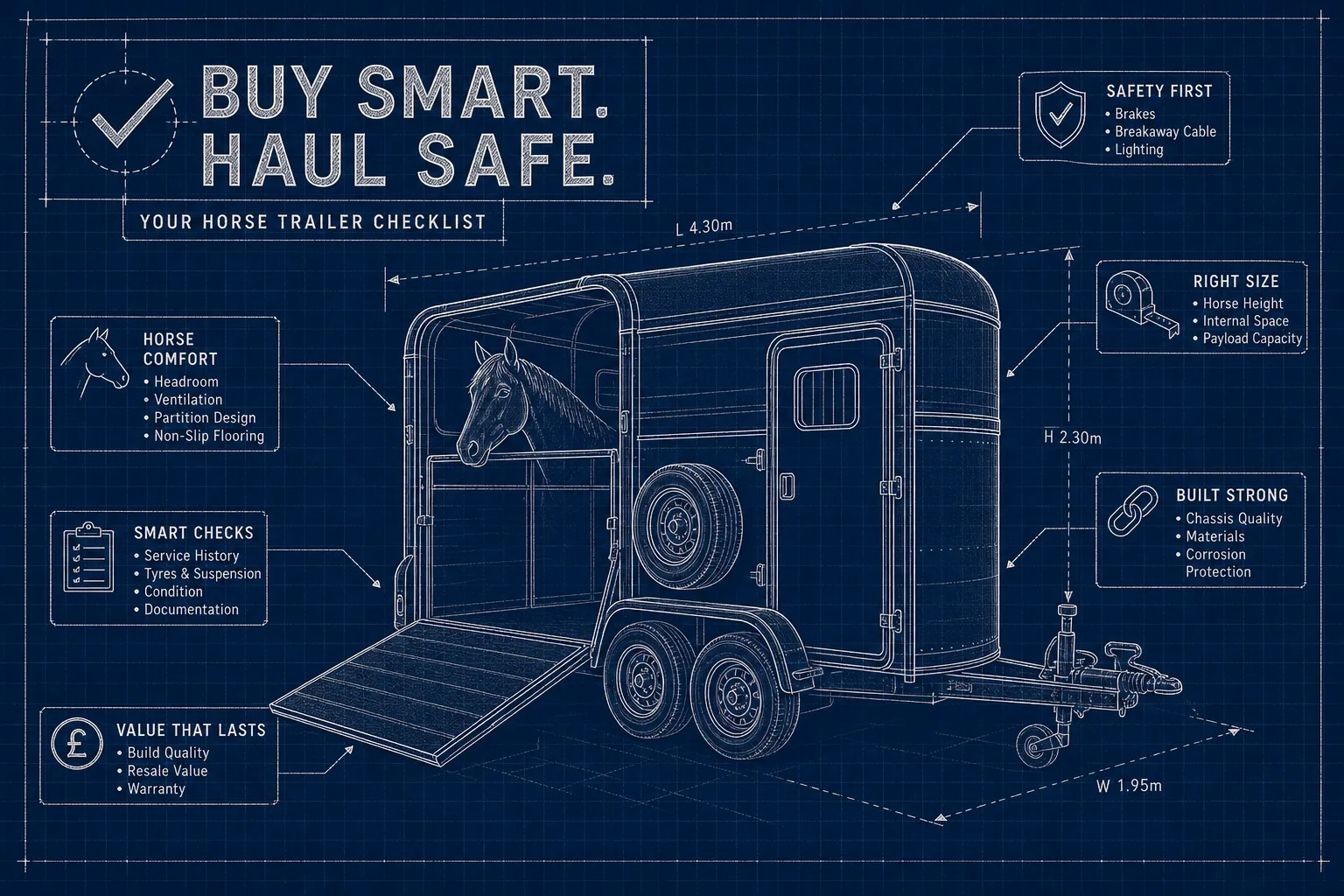
Buy the wrong horse trailer and you’ll know about it fast. A trailer that’s too cramped for your horse creates stress and injury risk on every journey. One that exceeds your tow car’s limits puts you on the wrong side of the law before you’ve left the yard. And a used trailer with a rotten floor hidden under rubber mats can cost more to repair than it’s worth. These aren’t rare horror stories; they’re often the predictable result of skipping steps in the buying process.
This horse trailer buying guide walks you through every decision in the right order: sizing your trailer to your horse, verifying your towing and licence entitlement, assessing safety features, understanding the price landscape, and running a thorough pre-purchase inspection before you hand over a penny. Once you know your horse’s measurements and your tow vehicle’s limits, RightFit Trailers offers a free personalised matching service to connect you with verified UK dealers, so you’re not starting from a blank search.
Work through these five areas and you’ll have everything you need to shortlist confidently, inspect thoroughly, and negotiate from a position of knowledge rather than guesswork.
1. Working out the right size for your horse and your plans
Sizing is the first decision, not something to revisit once you’ve fallen in love with a particular trailer. A stall that’s too short, too narrow, or too low forces your horse into an uncomfortable posture for the entire journey, creating physical stress and increasing the risk of injury to the animal and distraction for the driver. Getting dimensions right before anything else is essential.
Minimum internal dimensions: a horse trailer buying guide to height, length, and width by horse type
The UK rule of thumb for internal height is your horse’s withers height plus 75 cm. To put that in context: a horse standing 16 hands (approximately 162.6 cm at the withers) requires around 2.38 m (7 ft 10 in) of internal clearance, and a Warmblood or Thoroughbred at 17 hands (approximately 172.7 cm) needs at least 2.48 m (8 ft 2 in) by the same formula. Many UK manufacturers commonly cite 7 ft 6 in to 7 ft 8 in as a practical working minimum for larger breeds, though buyers should always verify against the formula for their own horse rather than relying on a single figure. Stall length should be a minimum of 10 ft (3.05 m) for medium-sized horses and 11 ft (3.35 m) for larger breeds. For width, 32 to 36 inches (81 to 91 cm) covers most riding horses, but horses above 17 hands benefit from 40 inches (102 cm) of stall width. Entry-level trailers are often marketed with dimensions that suit an average horse; those dimensions do not suit a large one, and no amount of padding compensates for insufficient space.
Single vs double: choosing the right configuration for how you actually travel
A single-stall trailer is lighter, easier to manoeuvre, and often significantly cheaper than a two-stall equivalent. If you own one horse and rarely need to transport a second, it’s worth asking honestly whether you’re buying the two-stall trailer for practical reasons or for flexibility. That said, a well-specified double does hold resale value well and is easier to sell on. Forward-facing stalls suit most horses instinctively and are the standard UK configuration; herringbone or angled layouts save length at the cost of some individual stall space, which matters more for larger breeds.
When a tack room is worth having (and when it just adds weight)
A tack room adds useful storage but it also adds weight, overall trailer length, and cost. If your horse is close to the trailer’s payload limit once you’ve accounted for tack, saddles, and rugs, the weight of a built-in tack compartment will eat directly into that margin. A straightforward guideline applies here: if the combined weight of your horse and all equipment you typically transport brings you close to the trailer’s payload rating, leave the tack room off the specification. If you have headroom to spare, the convenience is worth having.
2. UK towing rules you must verify before you buy
Towing law catches more buyers out than any other aspect of the process, usually because the three separate checks required are treated as one vague question about whether the car “can tow it.” They can’t be combined; each must pass independently.
Category B licence limits and the 750 kg MAM rule explained
If you passed your car test on or after 1 January 1997, your Category B licence permits you to tow a trailer with a maximum authorised mass (MAM) up to 750 kg without additional entitlement. Above 750 kg MAM, you can still tow on Category B provided the combined MAM of your car and the trailer does not exceed 3,500 kg. Anything beyond that requires a B+E entitlement. Drivers who passed before 1 January 1997 generally hold broader towing entitlement, typically up to 8,250 kg gross train weight for the combination, subject to the vehicle’s own limits. Critically, the licence check is based on the trailer’s plated weight, not what it weighs empty on the day you inspect it.
How to read your car’s braked towing capacity and gross train weight
Three figures control what your car can legally and safely tow: the braked towing capacity (the maximum a braked trailer can weigh when loaded), the vehicle’s gross vehicle mass (GVM), and the gross train weight (GTW), which is the maximum combined mass of the loaded car and loaded trailer together. Find these on the VIN plate, in the owner’s manual, or on the manufacturer’s data site. For a clear explainer on these limits see understanding towing limits and weights in the UK. The GTW minus the loaded vehicle weight gives you the actual maximum trailer weight you can tow on that trip. A car rated to tow 1,800 kg that’s already carrying 400 kg of passengers and kit has less than that available for the trailer.
Why loaded weight is the only number that matters for legal compliance
Consider a practical scenario: a family SUV with a 2,000 kg braked tow rating and a GTW of 5,000 kg, loaded with two adults and 150 kg of kit, has a vehicle mass around 2,500 kg, leaving 2,500 kg of train weight available for the trailer. A mid-sized two-horse trailer carrying an average horse at 550 kg, plus rugs, feed, and tack, can easily reach 1,900 to 2,100 kg in total, this is an illustrative example and actual weights will vary by horse and equipment. That combination is legal in this scenario, but only if three checks all pass:
- Your licence entitlement covers the trailer’s plated weight
- The trailer’s loaded weight stays within your car’s braked towing capacity
- The full combination stays within the GTW
Skip any one of these and the check is incomplete.
3. Safety and comfort features that make or break a horse trailer
Once size and towing legality are resolved, assess the build quality and safety features that directly affect your horse’s welfare. Some of these can be retrofitted cheaply; others cannot, and getting them wrong on a used purchase is an expensive lesson.
Flooring: aluminium vs wood, and what failure looks like before it becomes a crisis
Aluminium floors are lighter, rot-resistant, and easier to clean, but they corrode over time, showing as pitting, white oxidation, and surface flex. Timber floors are warmer underfoot and well established, but they absorb moisture and deteriorate from below, often invisibly under rubber mats. Flooring failure is the most common costly repair on used trailers in the UK. Professional floor replacement typically runs £500 to £900 in a UK specialist workshop, rising substantially when the damage has spread to the frame beneath. Practical guidance on how to inspect horse trailer floors for rot or rust can help you spot early warning signs before you commit to a purchase: how to inspect horse trailer floors for rot or rust.
Ventilation, headroom, and temperature control on the road
UK welfare law requires that horses are transported in conditions that prevent overheating and distress, and adequate ventilation is part of that duty. A well-ventilated trailer has adjustable roof vents, opening windows at horse level, and an airflow design that moves fresh air through rather than just admitting it at one point. UK summers produce dangerously high trailer temperatures even on moderate days if the vehicle is stationary or moving slowly in traffic. The government’s guidance for horsebox and trailer owners explains the welfare expectations for ventilation and safe transport. Headroom above the sizing minimum is not a luxury: a horse that cannot move its head freely cannot balance itself properly during braking and cornering.
Ramps, partitions, latches, and why secondary safety features matter
Inspect ramp springs and hinges carefully. A weak or worn spring drops the ramp too fast and makes loading stressful; a failed hinge can cause the ramp to fall unpredictably. Partition locks and bolts should operate positively with no rattle or slop. Door latches must close securely with no tendency to work loose over a long journey. An escape door on the front of the trailer is worth prioritising if you regularly handle horses alone, as it removes the need to go around the ramp side in an emergency.
4. New vs used horse trailers: prices, depreciation, and what to budget
Understanding the price range before you start viewing trailers stops you overpaying for used stock and helps you assess whether a new trailer is worth the premium.
What horse trailers typically cost in the UK market right now
Current UK market pricing breaks down roughly as follows:
- Small trailers: new around £7,500 to £8,000; used around £2,850 to £4,250
- Medium trailers: new around £8,000 to £15,000; used around £4,000 to £8,000
- Large and premium trailers: new from £15,000 to £20,000 and above; used from around £7,350
Depreciation runs at roughly 45 to 65% from new across the market, which makes a well-maintained used trailer genuinely attractive value. Brands with established reputations for build quality, such as Ifor Williams and Cheval Liberté, tend to hold their value better and are generally easier to sell on at resale.
When buying used makes sense and when it carries too much risk
The case for buying used is straightforward: significant savings, faster availability, and the ability to see how a trailer has performed in real use. The risk is structural damage that isn’t visible without a thorough inspection and can cost more to put right than the trailer is worth. The tipping point isn’t price alone; it’s the quality of the inspection you’re willing and able to carry out before committing.
How specification and build quality affect long-term resale value
Buyers who stretch their budget for a well-specified trailer from an established UK manufacturer typically recover more at resale than those who opt for a cheaper, lower-quality build. A poorly built trailer depreciates to a point where it becomes unsellable because the repair cost exceeds its market value. The purchase price is only part of the financial picture; resale value and ongoing maintenance costs complete it.
5. How to inspect a used horse trailer: a buying guide checklist
A systematic inspection at the point of viewing protects you from the most common and costly faults. Work through it in a fixed order: structure first, running gear second, paperwork last.
Floor and chassis first: where expensive faults hide
Lift every mat before you look at anything else. Run your hand across the floor surface and apply firm pressure underfoot across the full length of each stall. On timber floors, probe for softness, give, staining, and any flex that indicates the boards have lost structural integrity. On aluminium, look for pitting, white corrosion deposits, and any section that bends rather than holds firm.
Pay close attention to the edges, drain holes, and the area immediately inside the ramp, where water collects. Then get underneath the trailer and inspect crossmembers, frame joints, and welds for rust, cracking, or evidence of previous repairs. In the UK, a floor rot repair typically costs £500 to £900 at a specialist workshop; if the frame beneath has corroded too, combined costs of £800 to £1,500 or more are realistic. Know those numbers before you view and use them as your walk-away benchmark.
Brakes, axles, electrics, and lights: the running gear walkthrough
Check tyre wear patterns across the full width of each tyre. Cupping or heavy wear on one edge points to axle or alignment problems that go beyond the tyres themselves. Grab each wheel and check for bearing play by rocking it at the twelve and six positions. Inspect brake cables and the breakaway system for corrosion, fraying, or kinking. Then connect the trailer to your tow vehicle and walk around it while someone operates the lights, indicators, and brakes. Electrical faults that don’t show under visual inspection often appear under load, and discovering them before you sign anything puts you in a much stronger negotiating position.
Paperwork, red flags, and using the inspection to negotiate
Ask for service records, any plating documents, and evidence of brake servicing. A seller who can’t produce any maintenance history for a five-year-old trailer is a red flag; walk away or price the unknown risk into your offer. Every fault you identify during the inspection is a concrete, costed reason to reduce the asking price: a floor that needs professional attention isn’t a vague concern, it’s a £500 to £900 line item. Use it. If the faults are structural and widespread, walk away. If you’d prefer to reduce inspection risk from the outset, RightFit Trailers’ verified dealer listings are a sensible starting point: dealers on the platform are independently checked, which removes a layer of uncertainty from the process.
Buying with confidence: the decision order that saves money
Use this horse trailer buying guide as your checklist when viewing trailers and negotiating price. Follow the sequence and you’ll avoid the mistakes most buyers make:
- Size first, match the trailer to your horse’s actual measurements, not to a generic category
- Towing legality second, run all three checks against your licence entitlement, your car’s braked tow limit, and the gross train weight before committing to a specific model
- Features and build quality third, prioritise what’s hardest to retrofit, especially flooring and ventilation
- Inspection last if buying used, treat it as a structured walkthrough rather than a quick look around
Most buying mistakes happen because one of those steps gets skipped under time pressure or enthusiasm. None of them take long to complete, but each one protects you from a different and avoidable cost.
If you want a shortcut through the process, RightFit Trailers offers a free budget evaluation and personalised trailer matching service, connecting buyers with verified UK dealers across all major trailer categories. Head to RightFit Trailers, enter your horse’s details and tow vehicle, and let the platform do the shortlisting for you. For additional independent buying advice on choosing the right trailer for your horse, see finding the right trailer.