
Choose the wrong vehicle transport trailer and the consequences range from inconvenient to genuinely expensive. A splitter scraped clean off a low-slung sports car on a fixed ramp. A tow car pushed beyond its plated gross train weight, putting both the driver and the load at legal risk. An insurance claim rejected because the trailer wasn’t rated for the vehicle it was carrying. These are real outcomes, and they happen regularly to buyers who skip the groundwork.
There are four distinct categories of vehicle transport trailer on the UK market, and each one is designed around a different set of priorities. The right choice depends on what you’re moving, how often you’re moving it, and what your tow vehicle and licence actually allow. Once you understand those filters, the decision becomes straightforward. RightFit Trailers was built to help buyers apply exactly that framework, with personalised guidance and a free budget evaluation that removes the guesswork. This guide walks you through the process step by step.
The four main types of vehicle transport trailer
These aren’t simply different sizes of the same thing. Each type solves a different problem, and treating them as interchangeable is where many buyers go wrong. The right starting point is understanding what each category is actually designed to do, then matching it to your vehicle and journey type.
Open car transporters: the practical everyday choice
Open car carrier trailers are the most widely available option in the UK and the most affordable to buy or hire. They use an open deck with wheel straps or ratchet tie-downs and rear loading ramps, and they suit the vast majority of standard road cars: family hatchbacks, saloons, and small SUVs. The loading process is straightforward, the trailers are common at hire depots across the country, and the price point is accessible for both one-off and regular use.
The trade-off is protection. An open car hauler trailer exposes the vehicle to road debris, weather, and visibility from other road users. For a used daily driver being relocated between properties, that’s an entirely acceptable compromise. For a freshly restored classic or a competition car with painted bodywork, it isn’t. Know what you’re carrying before you commit to this category.
Enclosed trailers: built for protection and discretion
Enclosed car transporter trailers fully surround the vehicle, shielding it from stone chips, weather, and prying eyes. They’re the right choice for classic car restorations heading to a show, motorsport-spec vehicles on a motorway run, or high-value imports where road debris protection matters during transit. The vehicle arrives exactly as it left, which justifies the premium for the right buyer. For a straightforward comparison of the trade-offs between covered and open transport, see this enclosed versus open car transporting comparison for practical differences and typical use-cases: enclosed vs open car transporting.
That premium is real. Enclosed trailers cost 30, 60% more than open equivalents to buy or hire, and they carry higher insurance premiums because both the equipment and its typical cargo are more expensive to replace. For buyers who transport high-value vehicles regularly, that cost is part of the job. For buyers moving a standard road car once a year, it rarely makes sense.
Tilt bed and flatbed trailers: loading ease for awkward vehicles
A tilt bed trailer, sometimes called a beavertail or tilt-deck, works by pivoting the entire deck down toward the ground during loading. This creates a continuous shallow ramp rather than a fixed angle with separate loading ramps at the end. For a low-clearance sports car, a non-runner, or a vehicle on air suspension at ride height, that difference is critical. A standard ramp on a fixed flatbed can mean a £3,000 front splitter gets scraped off during loading; a tilt deck eliminates that risk entirely.
A fixed flatbed suits heavier, more robust loads that have adequate ground clearance and don’t need the reduced loading angle. Both configurations sit at the higher end of the open-style cost spectrum, and tilt beds carry additional cost for the pivoting mechanism. If you’re regularly loading low-slung or non-running vehicles, the tilt bed’s mechanical advantage is worth paying for.
Matching the trailer to your vehicle and journey
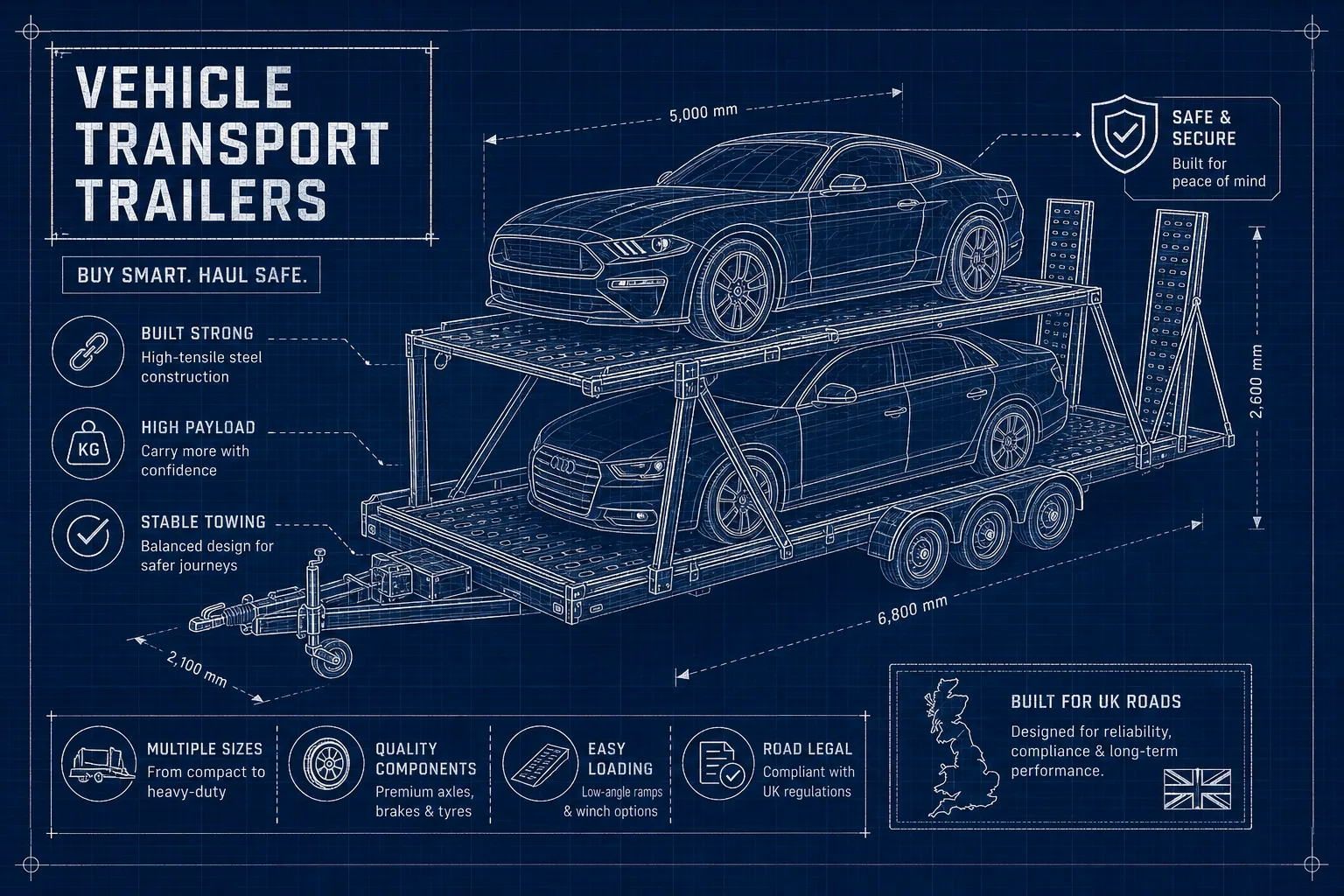
Type selection narrows the field. Journey and vehicle specifics close it. An open twin-axle vehicle transport trailer with a bed length of 4.0 to 5.0 metres and a payload of 1,500 to 2,100 kg covers the vast majority of standard hatchbacks, saloons, and small SUVs moving between properties, fleet relocations, or local recovery jobs. That configuration handles most everyday scenarios without overcomplicating the setup.
Classic cars, race vehicles, and high-value transport change the calculation. The enclosed option justifies its premium through stone chip protection on motorway runs, reduced insurance exposure, and security during overnight stops. For motorsport competitors attending regular track days, buying an enclosed trailer makes more financial sense than repeated hire. Verify that the bed width suits your car’s track before committing: wide-track competition cars need significantly more deck width than a standard road car.
Non-runners, air-suspended vehicles, and cars with aggressive aero require the tilt bed approach. Where a standard ramp creates a loading angle that risks bodywork contact, a tilt deck removes the problem at source. For vehicles above the typical payload range or on longer decks, a tri-axle configuration handles loads from 2,500 kg upward on decks up to 6.5 metres, giving the capacity headroom for heavier or longer vehicles.
UK towing laws and licence requirements
This is the legal filter that often narrows a buyer’s shortlist more than anything else. Many people discover that their licence or tow car limits their options only after identifying a trailer they want to buy.
What your Category B licence actually allows
The post-1997 and pre-1997 split is one of the most commonly misunderstood rules in UK trailer ownership. Drivers who passed their car test on or after 1 January 1997 can tow a trailer up to 3,500 kg MAM under Category B, provided the towing vehicle’s own limits allow it. Drivers who passed before that date typically carry pre-1997 entitlement covering combined weights up to 8,250 kg MAM. Check your licence photocard carefully before you assume which category applies to you.
Weight limits, dimensions, and the VIN plate rule
When the towing vehicle’s MAM is 3,500 kg or under, the trailer cannot exceed 7 metres in length and 2.55 metres in width. More critically, the towing vehicle plus fully loaded trailer cannot exceed the gross train weight shown on the vehicle’s VIN plate. If the VIN plate shows no train weight figure, that vehicle cannot legally be used for towing. This single rule eliminates a surprising number of otherwise capable tow cars and is worth checking before any other specification. For the official summary of permitted towing weights and width limits, refer to the government’s guidance on towing with a car: towing weight and width limits.
When you need a higher licence entitlement
Buyers looking at tri-axle car carrier trailers or heavier enclosed race transporters may find they’re moving into territory that requires BE, C1+E, or another higher entitlement. Under DVLA rules, towing a trailer above 3,500 kg MAM on a post-1997 Category B licence is not permitted. C1+E entitlement covers vehicle-and-trailer combinations up to 12,000 kg MAM, but obtaining it requires passing the lorry theory test and a separate driving test. Check your entitlement with DVLA before committing to a purchase your current licence cannot legally cover.
Key specs to check before you commit
Once the type is confirmed and the legal picture is clear, the actual vehicle transport trailer specification needs scrutiny. Headlines can mislead; the plate figures tell the real story.
Payload capacity and axle configuration explained
Single-axle models typically offer 1,000 to 1,200 kg payload on beds of around 3.5 to 4.1 metres. Twin-axle configurations extend that to 1,500 to 2,100 kg across 4.0 to 5.0 metre decks, while tri-axle setups handle 2,500 kg or more on decks reaching 6.5 metres. Payload equals the trailer’s gross weight rating minus its unladen weight. Always check both figures on the trailer’s plate, not just the headline gross number, because a trailer with a 2,000 kg gross rating and 500 kg unladen weight gives you 1,500 kg of usable payload, not 2,000 kg.
Bed dimensions, tie-down points, and ground clearance
Bed width matters as much as length. A car with a wide track or flared arches needs significantly more deck width than a standard hatchback, and a trailer that looks long enough on paper can still be too narrow for the vehicle you’re carrying. Verify tie-down rail positions against your vehicle’s jacking points, and confirm whether the trailer includes wheel straps, chassis straps, or both. Inadequate tie-down equipment is one of the most common causes of transit damage and the first thing a loss adjuster will ask about after an incident. For straightforward guidance on recommended deck sizes and how they match to vehicle types, see this car trailer size reference: car trailer size guide.
Brakes, coupling type, and type approval
Under UK law, trailers over 750 kg laden must have an overrun braking system. For car transporter trailers, also described in listings as a vehicle carrier trailer, that requirement covers almost every practical configuration. Check the coupling type: standard 50mm ball, BPW, or AL-KO coupling heads are the most common on UK car hauler trailers, and the coupling must match your tow vehicle’s hitch. For used trailers, verify that a valid type approval plate is present. Not every second-hand trailer on the market carries proper approval documentation, and a trailer without it is not road-legal regardless of its physical condition. For official advice on maintaining roadworthiness and the legal obligations for brakes and type approval, consult the government’s guide to maintaining roadworthiness: guide to maintaining roadworthiness.
Buying vs hiring: what actually makes financial sense
New open twin-axle car transporters in the UK run from approximately £3,065 to £6,665 inc VAT, using the Ifor Williams CT range as a useful benchmark. Heavy-duty beavertail configurations reach around £7,824 inc VAT. Enclosed and race transporter trailers sit between £9,400 and £29,420 or more before VAT. On the used market, the active price range clusters between £4,000 and £16,000 depending on age, condition, and type. Established brands like Ifor Williams and Indespension hold their resale value significantly better than lesser-known alternatives, which matters if you’re thinking about selling in three to five years.
Hire rates for open car transporter trailers from UK hire depots average around £77 per day and £308 per week, with daily rates running from £49 to approximately £113 depending on size and location. For buyers who transport vehicles fewer than six times a year, or who need an enclosed trailer for a single event, hiring a specialist vehicle transport service makes better financial sense. Professional vehicle transport runs approximately £0.95 to £1.30 per mile on longer routes and £2 to £3 per mile on short local moves. A buyer paying £250 to £400 for an occasional professional job rarely justifies a £6,000 to £15,000 trailer purchase on three uses annually. The crossover point is typically around eight to ten transports per year for an open trailer, and more frequent use for enclosed configurations given their higher purchase price.
Where to source a reputable vehicle transport trailer in the UK
The risk of buying from an unverified source is specific and quantifiable. A trailer without type approval documentation, from a seller who can’t confirm payload figures or provide any post-sale support, can cost thousands in rectification if the specification turns out to be wrong for the tow car or the vehicle being carried. The difference between a £4,000 used trailer from a reputable dealer and a £3,500 one from a private listing is often not £500; it’s the paper trail, the warranty, and the honest conversation about whether this trailer actually suits your setup.
Look for dealers who can provide verified type approval paperwork, transparent unladen weight and payload figures, and clear confirmation that the model suits your tow vehicle’s rated capacity. Post-sale warranty and parts availability matter more than they seem at the point of purchase, particularly for mechanical components like coupling heads and braking systems on well-used trailers.
RightFit Trailers is built specifically to solve the problem this guide addresses. Rather than sending buyers into manufacturer spec sheets or unverified classified listings, the platform provides independent, use-case-specific guidance matched to your vehicle, tow car, and budget. The free budget evaluation pairs you with options within your actual price range, and the personalised fit recommendation means you’re not relying on a dealer’s incentive structure to narrow the field. The Perfect Match Guarantee provides an additional safeguard that a standard classified listing cannot replicate. If you’ve worked through this guide and know broadly what you need, RightFit Trailers is the logical next step toward confirming the right specific model from a verified UK supplier.
Making the final call with confidence
The decision framework comes down to four steps applied in order: identify the vehicle transport trailer type that fits your use case, confirm your licence and tow car limits, check the payload and bed dimensions against your vehicle, then decide whether buying or hiring makes financial sense for how often you’ll use it. Apply those filters in sequence and the shortlist shrinks quickly from confusing to manageable.
Choosing the right vehicle transport trailer is genuinely straightforward once the groundwork is done. The complexity most buyers feel comes from starting with price or brand before sorting out the legal and specification requirements. Start with the filters, not the listings. If you’d rather have a personalised recommendation than work through it from scratch, RightFit Trailers is there to do exactly that.