

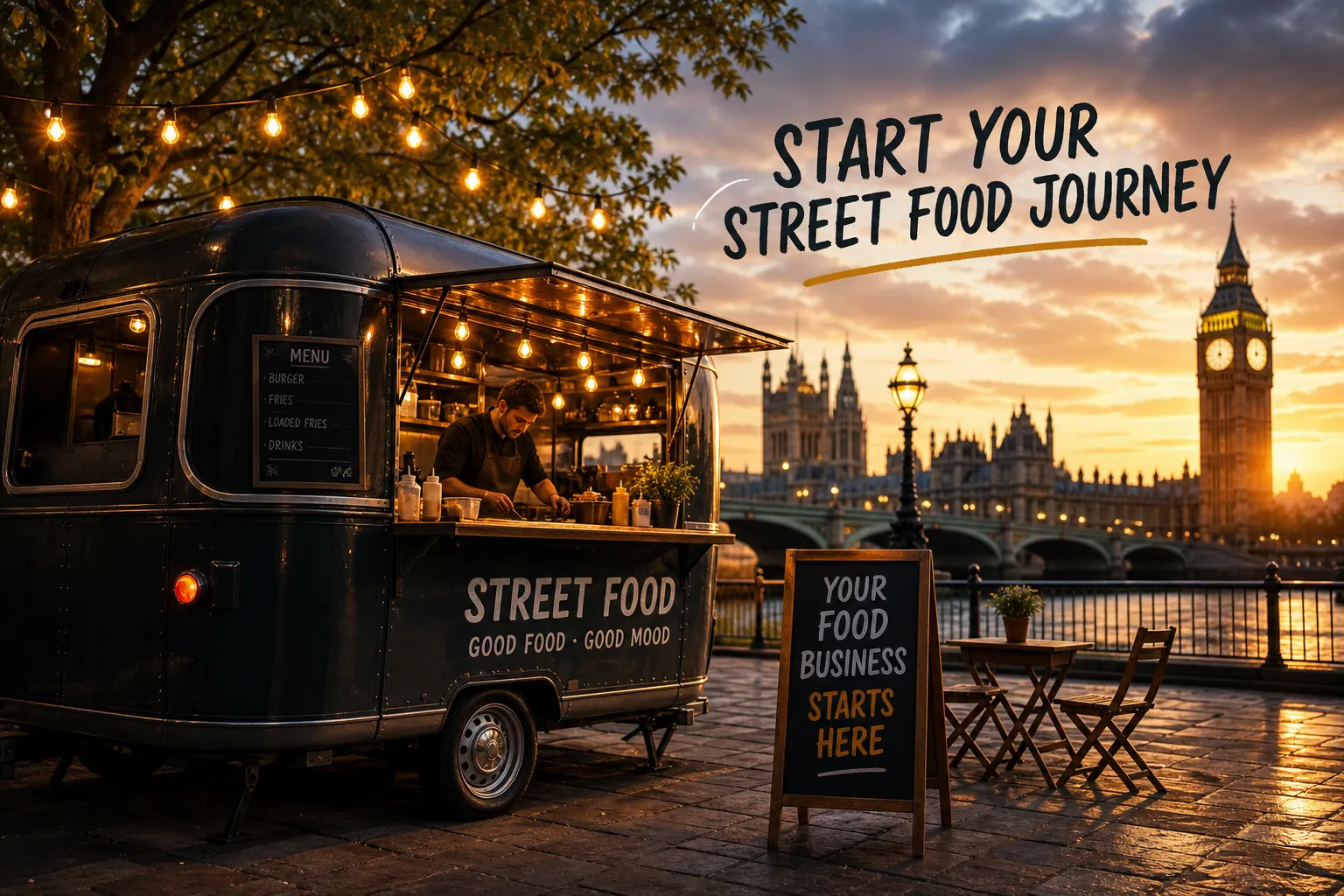
You’ve got the concept nailed, a name you’re proud of, and a catering trailer brochure you keep coming back to. What you don’t have yet is a clear idea of where to start, or in what order. That’s exactly where most people find themselves before their first trade, and the gap between a food idea and a legally trading street-food business is wider than a single Google search makes it look. A solid street food trailer setup demands more than enthusiasm: it requires a specific sequence of decisions, each one building on the last.
Getting a mobile kitchen off the ground in the UK involves the right trailer, a compliant fit-out, food registration, gas and electrical sign-off, pitch permissions, and a budget that accounts for what year one actually costs. None of these steps is complicated, but skipping any one of them can delay your launch by weeks or land you with a council inspector turning you away from your first pitch. This guide walks through every stage in practical order, so you know exactly what to tackle and when.
The trailer itself is the foundation. Every other decision, from kitchen layout to tow vehicle to running costs, flows from the unit you choose. Before you commit to anything, it’s worth comparing verified catering trailers from across the UK in one place. RightFit Trailers offers a free budget evaluation and use-case matching tool that helps narrow the field before you spend a pound, making it a sensible first stop for anyone at the research stage.
Street food trailer setup: choosing the right catering trailer for your menu
What size and spec do you actually need?
Menu type drives trailer size more than most buyers expect. A coffee or crepe concept can operate comfortably from a compact 10ft to 12ft unit. A full grill setup with fryers, hot holding equipment, and separate prep space needs considerably more room, typically 14ft or longer. The key specifications to compare are internal working length, gross vehicle weight (GVW), tow car compatibility, and whether the unit arrives with a gas-ready fit-out or as a bare shell you’ll need to equip yourself.
Undersizing is the most common beginner mistake, particularly for operators who plan to expand their menu in year two. A unit that feels adequate on day one becomes a bottleneck within months if you add equipment or a second menu line. Buy for where you realistically expect to be in 18 months, not just where you are today.
New, used or custom-built: weighing your options
New trailers offer warranty coverage and compliance peace of mind, but the purchase price reflects both. If you’re looking to buy a catering trailer in the UK, a used unit in reasonable working condition typically asks between £8,000 and £20,000 on the current market, making it the most accessible entry point for most first-time operators. That said, a second-hand unit needs a thorough pre-purchase inspection, including gas installation records, electrical certificates, and evidence that the structure meets current UK type approval standards.
Custom-built trailers suit unusual concepts or operators who need a very specific layout, but they involve longer lead times and higher upfront costs, often £20,000 or more depending on specification. Whatever route you take, verify compliance documentation before money changes hands. A trailer without a valid gas installation certificate or an Electrical Installation Condition Report (EICR) is not just a paperwork problem; it can prevent you from trading at all.
How RightFit Trailers helps you compare before you commit
Rather than trawling dozens of classified listings with inconsistent information, RightFit Trailers lets you filter verified catering trailer options across the UK by budget, use case, and trailer category. The free budget evaluation matches your spending range to realistic options, and the platform’s use-case matching surfaces units suited to your specific menu type. There’s no sales pressure and no dealer upsell, it’s a research tool designed to help you make an informed decision before committing to a purchase.
Street food trailer setup: designing a mobile kitchen layout that works
Single-operator layouts: galley, L-shaped and U-shaped
Three layouts dominate single-operator street-food trailers. A galley arrangement runs equipment along one or both long walls and suits narrow units with a straightforward menu. An L-shaped setup separates prep and cooking more clearly, which is useful when cross-contamination control between raw and ready-to-eat food is a priority. A U-shaped mobile kitchen layout is often the most efficient for one person because prep, cooking, and service all sit within arm’s reach, minimising unnecessary movement during a busy service.
The goal of any layout is a logical workflow that reduces steps and keeps raw and cooked zones clearly separated. Plan the sequence from the moment ingredients arrive at the trailer through to the moment food reaches the customer, then design the space around that flow rather than around the equipment you happen to own. For practical guidance on designing compact but compliant kitchens, see advice on how to design a food truck kitchen that balances workflow and safety.
Trailer kitchen equipment list and workspace clearances
The core kit for most catering trailers includes commercial cooking appliances, refrigeration, a two- or three-compartment sink, food-safe worktops, and lockable storage for dry goods. UK council inspectors expect commercial-grade equipment throughout. Domestic appliances are not acceptable in a food business, regardless of how rarely you intend to use them.
On space, a clear aisle width of at least 900mm is the practical minimum for a solo operator, with 1,200mm preferred where the layout allows. Anything narrower and movement becomes restricted during service, which increases the risk of burns and spillage. Factor clearances into your layout planning before specifying equipment sizes, not after.
Licences, food registration and legal compliance
Registering your food business: the non-negotiable first step
Every food business in the UK must register with the local authority’s Environmental Health department at least 28 days before trading begins. Registration is free, cannot be refused, and is entirely separate from any street trading permission. You also need a documented food safety management system based on HACCP principles, covering hazard identification, controls, and monitoring records.
A Level 2 food hygiene certificate is not a strict legal requirement under UK law, but councils and insurers treat it as standard. Without it, you’re likely to face questions during your food safety inspection that a certificate would have pre-emptively answered. Get it done early, most online courses take less than a day to complete.
Street trading licences vs consent: understanding the difference
Public streets in the UK are designated as either licensed streets, consent streets, or streets where trading is prohibited entirely. Licensed streets require a full street trading licence from the relevant council. Consent streets require a lighter form of written consent. The rules vary sharply between councils and even between streets in the same town, so you must contact each local authority for every pitch you intend to use rather than assuming the rules are consistent.
Trading on private land sidesteps the street trading rules, but you still need the landowner’s written permission and, in all cases, your food business registration remains required. Markets are usually handled through the market operator or council market team rather than a standard street trading application. Never assume permission: always confirm in writing before setting up.
Conditional licences worth knowing about
If you sell alcohol, or serve hot food or drinks between 11pm and 5am, you need both a premises licence and a personal licence on top of your street trading permission. These are issued by the licensing authority, not Environmental Health, and the application process takes time. Public liability insurance, risk assessments, and vehicle documents are commonly requested at application stage across both food registration and street trading applications, so assemble that paperwork before you start applying rather than scrambling for it mid-process.
Gas, electrical and ventilation sign-off
LPG compliance and your Gas Safe certificate
All gas installation, commissioning, and servicing work must be carried out by a Gas Safe registered engineer who holds mobile catering competence. The trader must hold a gas installation certificate for the LPG system and keep annual service records. LPG cylinders must be securely fixed in a ventilated compartment, appliances must not be operated while the trailer is moving, and flexible hoses must meet BS 3212 Type 2 specification where applicable.
Commissioning a new LPG installation typically costs from around £100 per appliance tested, with call-out charges on top depending on location. Expect the engineer to check for leaks, verify regulator pressure, and confirm that each appliance is burning correctly before signing off the certificate. Budget for this as a non-negotiable line in your street food trailer setup costs: trading without a valid gas certificate is not a risk worth taking. For further information on commercial kitchen gas and electrical safety best practice, refer to specialist guidance on commercial kitchen gas and electrical safety.
Electrical installation and PAT testing requirements
The trailer’s fixed electrical system must comply with BS 7671 and the Electricity at Work Regulations 1989, evidenced by a fixed electrical installation certificate or EICR (Electrical Installation Condition Report). RCD protection is required for outlets near water sources. Portable appliances should have current PAT test records. Both councils and insurers commonly request these documents during application, so have them ready before approaching any pitch or event organiser.
Extraction and ventilation: what inspectors look for
Cooking equipment that produces grease-laden vapour requires a Type I extraction hood with grease filters and properly sealed ducting. Most systems also need an interlock that cuts the gas supply if the extraction fan fails. LPG cylinder compartments must be ventilated directly to the outside at both high and low level. Insufficient extraction is one of the most common reasons catering trailers fail a council inspection. Get a gas engineer or fire safety officer to review the ventilation setup before your first pitch rather than discovering a problem at the worst possible moment. For more detail on exhaust and fan safety expectations, see guidance on fire safety requirements for food truck exhaust fans.
Finding a pitch and securing trading permissions
Public streets, markets and events: which permission applies where
Public streets and town-centre pitches need a street trading licence or consent from the council. Market pitches go through the market operator or council market team. Events and festivals require written permission from the event organiser and sometimes a Temporary Event Notice, depending on trading hours and what you’re selling. For new operators, smaller local events, community festivals, retail parks, and lunchtime town-centre spots are the most accessible starting points, pitch fees at local events typically run from around £500, compared to several thousand pounds at major festivals where competition for spaces is intense.
Applying for a pitch: the practical order of steps
Register your food business first, then identify the pitch and confirm its designation with the relevant council. Submit your street trading application with supporting documents including insurance, food safety evidence, and vehicle details. For private land or event sites, secure written landowner or organiser permission separately. Application timescales vary widely between councils, so start the process several weeks before your intended trading date and follow up proactively rather than waiting for the council to come to you.
Budgeting for your street food trailer setup
What a mobile catering trailer fit-out costs
As outlined earlier, used catering trailers in good working order typically sit in the £8,000 to £20,000 range on the UK market. A new custom-built unit with a full mobile catering trailer fit-out runs from £20,000 upward. Beyond the headline purchase price, factor in gas commissioning, electrical certification, signage, smallwares, and your initial stock order, these additional costs commonly add £2,000 to £5,000 on top of the trailer itself, regardless of whether you go new or used. For a broader view of typical vehicle and fit-out costs, see the industry breakdown of how much a food truck costs.
A DIY conversion on a bare trailer is possible at lower cost, but it demands significant time and technical knowledge to meet compliance standards. The money saved on the trailer can easily be offset by delays, rework, and inspection failures if the installation doesn’t meet requirements first time.
First-year running costs to plan for
The main ongoing cost lines are food supplies and consumables, pitch fees or event costs, public liability insurance, LPG and fuel, commissary or storage rental if you can’t keep the trailer at home, marketing, and any staff wages. Many first-time operators underestimate consumables and pitch fees, a busy trading schedule can run through £1,000 or more in raw materials per week, and pitch costs at quality locations add up fast.
A conservative contingency fund of 15 to 20 per cent on top of projected costs is sensible for an operator still learning which pitches and trading days perform best. Year one is as much about gathering data as it is about generating profit, so build a cash buffer that gives you time to refine your operation without financial pressure forcing rushed decisions.
Ready to start: your next practical step
A successful street food trailer setup follows a clear sequence: find the right trailer for your menu and budget, plan the mobile kitchen layout around a single-operator workflow, get the gas and electrical certificates in order, register the food business with Environmental Health, secure the correct pitch permissions, and go in with a realistic budget that includes a contingency. None of these steps is out of reach for a first-time operator who does the groundwork properly. For a concise starter guide covering steps from concept to trading, see a practical how to start a food truck checklist.
The trailer decision is where it all begins, and getting it right before you commit saves significant time and money further down the line. RightFit Trailers offers a free budget evaluation and verified listings across the UK’s catering trailer market. Use it to compare options without pressure and identify a unit that genuinely fits your concept before committing.