
If you’re wondering what you should look for when buying a horse trailer, the short answer is: more than most buyers check. The photos looked right. The price seemed fair. You’d already mapped the route in your head before you’d even booked the viewing. Then you arrived, walked around the trailer once, and realised you had no idea what you were actually looking at. That gap between confidence and knowledge costs buyers money every single time.
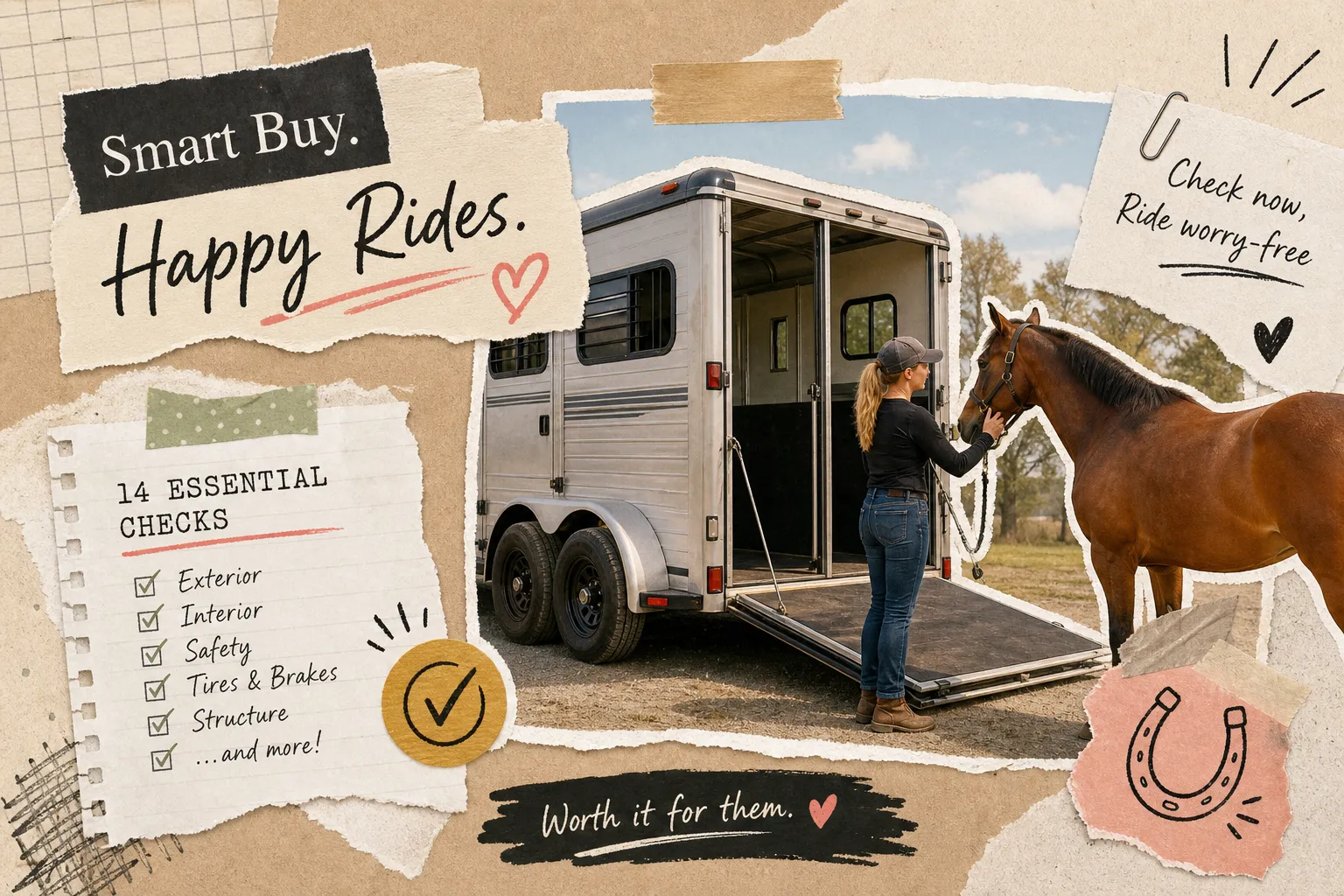
This checklist covers 14 specific checks across stall fit, structure, safety systems, and UK legal compliance. Work through them at any viewing and you’ll leave with a clear answer: proceed, negotiate, or walk away. Before you start viewing at all, it’s worth using RightFit Trailers to get a personalised recommendation based on your horse, tow vehicle, and budget. Knowing exactly what you’re targeting before you arrive makes every check on this list more useful.
What should I look for when buying a horse trailer: size and stall layout
Many buyers head straight to floor condition and price. Both matter, but a trailer that doesn’t physically suit your horse is a problem regardless of how well it’s been maintained. Confirm the fit first, then inspect everything else.
Check 1: Stall dimensions versus your horse’s actual measurements
Measure your horse at the withers, note body length, and check weight before you view anything. For a single trailer, look for a minimum internal height of 2.2m and an internal length of at least 3.08m, figures consistent with standard UK industry guidance. A 16.2hh warmblood needs noticeably more headroom and length than a 14.2hh cob, and those differences are real. Sellers may not volunteer measurements unprompted, so take your own figures to every viewing and ask directly.
Check 2: Partition design, breast bars, and loading configuration
Straight-load, forward-facing, and herringbone layouts each suit different horses. Check that partitions adjust to your horse’s width and that breast bars sit at chest height rather than across the neck or shoulder. A poorly positioned breast bar creates a welfare risk on every journey, it is not a minor inconvenience.
Check 3: Ramp angle, door width, and loading safety
Walk the ramp yourself and check the anti-slip surface for wear. A steep gradient and narrow door can make horses ramp-shy and increase the risk of loading injuries. Confirm the door width gives your horse a genuinely usable entrance before you spend any more time on the rest of the inspection.
Inspecting the floor, chassis, and build materials
Floor failure is the most expensive structural problem on used horse trailers and the easiest to miss on a casual walk-around. Take your time here, because a floor that looks fine underfoot can be rotted through at the frame joins.
Check 4: How to identify floor rot before it becomes a safety issue
Press firmly across the entire floor, working from the back door edge toward the front. Soft or spongy areas, flex underfoot, discolouration at wall-side joins, and a musty smell are all warning signs. Carry a screwdriver: if it probes into timber without resistance, the board has gone. Rot at the frame junction is significantly more serious than surface board damage, once the metal chassis is compromised, you are looking at a different scale of repair entirely. A full timber floor replacement runs from around £500 to £1,000 installed (based on 2026 UK estimates); frame repairs sit above that and should factor heavily into any negotiation.
Check 5: Aluminium, timber, or composite: what the build tells you
Identify the build material before you start inspecting, because it changes what you’re looking for. Composite resists rot, moisture, and pests best and needs the least maintenance long-term. Aluminium is lightweight and corrosion-resistant, but watch for dents and compromised joint sealing around fittings. Timber trailers need regular sealing, are prone to warping, and will typically require more repair work across their lifetime than either alternative. For a detailed comparison of options and their pros and cons, see this guide to horse trailer flooring.
Check 6: Chassis welds, wall panels, and roof seals
Inspect the chassis for rust blooms, paint scraping that suggests impact or rough use, and cracks at weld points. Then check the roof and wall sealing: lifted sealant strips and damp patches on interior walls are early signs of water ingress. Left unchecked, water ingress accelerates structural decay faster than almost anything else on a trailer.
Ventilation, interior condition, and horse welfare features
Check 7: Airflow, window condition, and roof vents
Open every vent and window fully, then check they latch securely in both positions. Mesh inserts should be intact, and windows should seal properly when closed without gaps that create wind chill on cold runs. Under UK transport welfare guidance, trailers must provide adequate ventilation; vents that are seized or stuck shut fail that requirement immediately.
Check 8: Rubber matting, kick boards, and interior padding
Lift the rubber mats if you can. Mats that haven’t been removed and cleaned will show urine saturation and early decay underneath the surface. Check for cracks, compression, and gaps at the edges where hooves could catch. Kick boards and padded walls should be complete, with no missing sections, splits, or loose fixings.
Check 9: Tie rings, hay net points, and lighting
Through-bolted tie rings are far more reliable than those screwed into the wall; test each one with firm pressure and check for any movement. Confirm that interior lighting works and that cabling is properly routed without visible damage from horse activity. These are small checks, but they reflect the overall standard of maintenance across the trailer.
What should I look for when buying a horse trailer: brakes, axles, and towing compatibility
This section determines whether the trailer is safe to move. Brake failure and axle issues are serious on any trailer; on a loaded horse trailer at 50 to 60mph, they are potentially catastrophic. Do not skip these checks or take them on trust.
Check 10: Wheel bearings, brakes, and axle condition
With the trailer safely chocked, spin each wheel and listen for roughness or grinding. Hold the tyre at the top and bottom and wiggle it: slight movement is normal, but obvious wobble points to worn bearings. Check the hub and seal area for grease leaks, which contaminate the brakes and reduce stopping power. After a short test move, feel the hubs: a hot hub or grinding noise is an immediate red flag that requires professional assessment before you consider proceeding. For a practical inspection checklist covering axles, brakes and suspension, see this resource on how to inspect towable axles and brakes.
Check 11: Coupling type, hitch compatibility, and breakaway cables
Common coupling types on UK horse trailers include 50mm ball, twin-ball, and eye couplings. Confirm compatibility with your tow vehicle before the viewing trip, not during it. Check the breakaway cable attachment point for corrosion and test the handbrake mechanism for full, reliable function.
Check 12: Matching your tow vehicle to the loaded trailer weight
A single horse trailer typically weighs between 700kg and 1,130kg empty; a double trailer runs from around 900kg to 1,800kg empty, with loaded weights often exceeding 2,250kg. Your tow vehicle must handle both the towing rating and the payload, which includes nose weight and any passengers. The practical safety margin for live loads is 80 to 85 per cent of your vehicle’s rated towing capacity. If you’re unsure whether your vehicle is suitable, RightFit Trailers offers a compatibility check as part of its personalised recommendation service. For a clear explanation of trailer weights and how they affect towing, see this overview of trailering weights explained.
UK legal requirements, documents, and paperwork
Check 13: Licence rules, MAM limits, and speed restrictions
If you passed your car test on or after 1 January 1997, you can tow a trailer up to 3,500kg MAM on a standard licence. Those who passed before that date are generally permitted a combined MAM of up to 8,250kg. For any combination over 3,500kg MAM, an HGV licence is required.
When towing, the limits are 50mph on single carriageways and 60mph on dual carriageways and motorways, and the outside lane of a three-or-more-lane motorway is off-limits. If you transport horses commercially over 65km or on journeys exceeding eight hours, a Certificate of Competence in animal transport is also required under the Animal Welfare (Transport) (England) Order 2006 and equivalent devolved legislation. For official government guidance on transporting horses in road vehicles, see the guidance for horsebox and trailer owners, and for practical notes on weights, speeds and everyday towing safety see this summary of UK horse trailer towing rules.
Check 14: What documents to ask for on a used trailer
Ask for the manufacturer’s plate or Certificate of Conformity, any service history, and receipts for previous brake or floor repairs. A missing plate doesn’t make a trailer illegal to buy, but it removes your ability to verify its legal identity and approval status. That shifts all the risk onto you, and the asking price should reflect it.
Using your checklist to negotiate, price repairs, or walk away
Once you’ve worked through all 14 checks, you’re in a position to make a real decision rather than an emotional one. Floor repairs, brake replacement, and rubber mat renewal are all priceable and usable as negotiating leverage. Get repair estimates before you make an offer, not after. Chassis cracks, twisted axles, and missing documentation sit in a different category: they’re not negotiating points, they’re risk signals that change the whole calculation.
If the combined repair cost brings the effective price close to what a comparable used trailer would cost from a reputable dealer, the answer is usually to walk away. RightFit Trailers lists verified sellers alongside a personalised recommendation service that matches you to the right trailer for your specific setup, horse, tow vehicle, and budget all considered.
Confident buyers leave with the right trailer
These 14 checks aren’t about being overly cautious. They’re about buying with confidence rather than hope. A buyer who works through this list either leaves with a trailer that genuinely suits their horse, or leaves without spending money on a mistake. Both outcomes are worth having.
Structural soundness, towing compatibility, ventilation, and legal compliance are all things you can assess yourself with the right framework. Now you have one. If you’d like to make sure you’re viewing the right trailers in the first place, so that what should I look for when buying a horse trailer has a clear answer before you even set off, RightFit Trailers can help you narrow the field before you go anywhere near a viewing.
Frequently asked questions
What should I look for when buying a horse trailer?
Focus on stall dimensions relative to your horse’s measurements, floor condition (especially for rot at frame joins), build material, ventilation, brakes and wheel bearings, coupling compatibility, loaded weight versus your vehicle’s towing capacity, and UK legal documentation. This 14-point checklist covers each area in detail.
How do I check for floor rot on a used horse trailer?
Press firmly across the entire floor and probe suspicious areas with a screwdriver. Soft timber that offers little resistance, discolouration at wall joins, and a musty smell are the key warning signs. Pay particular attention to the frame junction where floor boards meet the metal chassis.
What weight should I look for when buying a horse trailer?
Match the trailer’s gross vehicle weight (GVW) to your tow vehicle’s rated towing capacity, keeping the loaded combination within 80 to 85 per cent of that rating for a safe live-load margin. A single trailer typically runs 700, 1,130kg empty; always confirm the plate figures at the viewing.
Do I need a special licence to tow a horse trailer in the UK?
If you passed your car test on or after 1 January 1997, you can tow a trailer up to 3,500kg MAM on a standard Category B licence. Combinations over that threshold require an appropriate HGV entitlement. Commercial transport of horses over 65km or eight hours also requires a Certificate of Competence under animal transport legislation.