
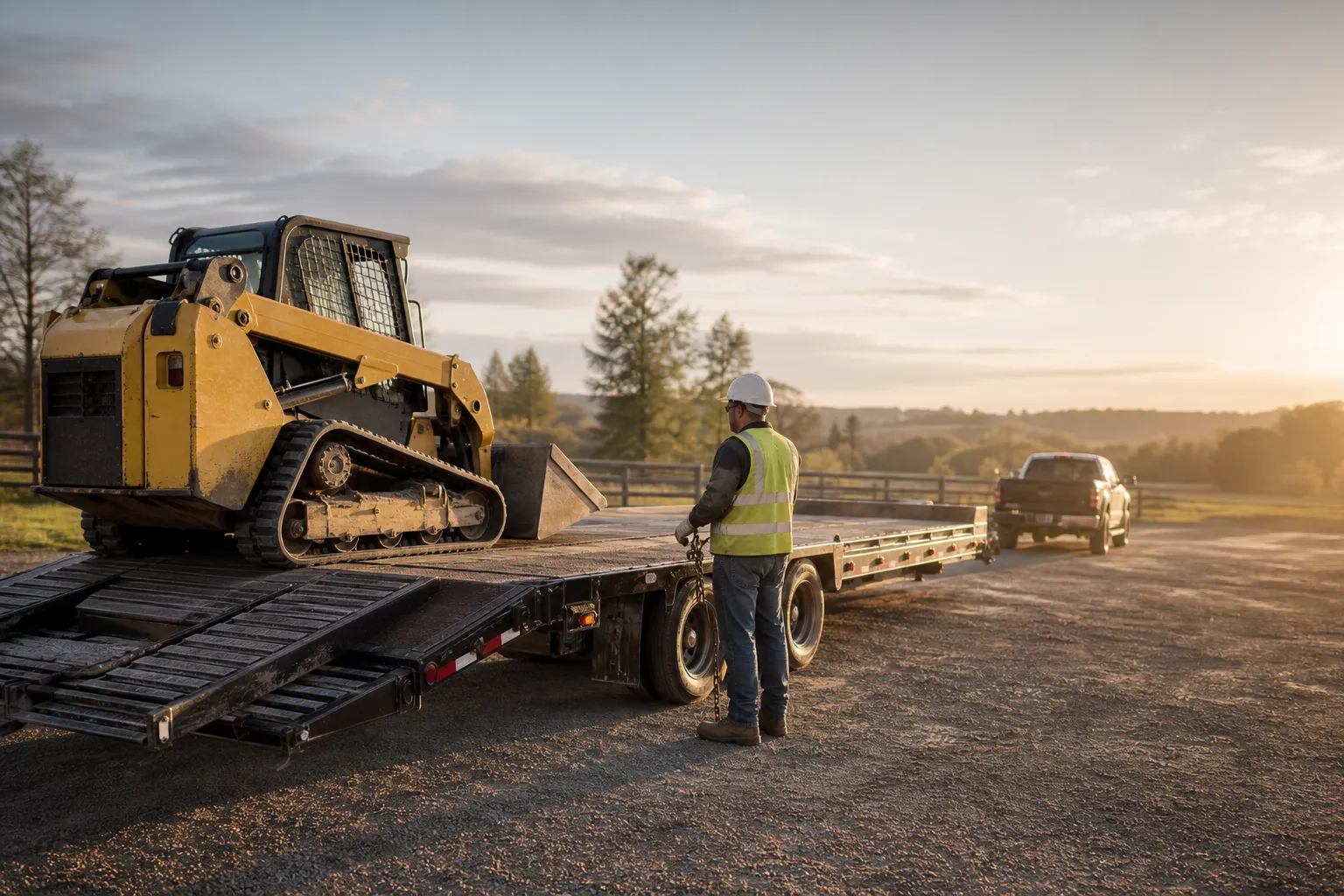
A poorly loaded excavator can cause a trailer to become unstable mid-journey, potentially leading to jackknifing. Using a ramp below its rated capacity risks sudden failure, always verify the ramp’s published rating before use. And a trailer that breaches its axle limits before it leaves the yard is already illegal, even if the driver hasn’t noticed. These aren’t edge cases: they’re the predictable result of skipping the preparation that makes loading heavy equipment onto a trailer safe.
This is a practical guide to loading heavy equipment trailer operations safely, covering the full process from start to finish. You’ll learn how to select the right trailer for your machine, calculate tongue weight and weight distribution, set ramp angles correctly, load and secure the equipment, and complete the pre-departure checks that keep you legal on UK roads. Whether you’re moving a 3-tonne mini digger or a 12-tonne excavator, the principles are consistent. Get the preparation right and the physical operation becomes straightforward.
Picking the right trailer for the job
Before you position a single ramp, you need confidence that your trailer can handle what you’re loading. Two trailer types dominate heavy plant transport: tilt bed and flatbed. Choosing between them isn’t a matter of preference, it depends on your machine’s ground clearance, weight, and how frequently you load it.
Tilt bed vs flatbed: what the choice really comes down to
A tilt bed trailer lowers its deck to ground level, which removes the need for separate ramps entirely and eliminates the breakover point that causes undercarriage damage on low-clearance machines. A flatbed trailer is more versatile for irregular or taller loads but requires well-rated ramps and careful angle management on every load. If you’re comparing configurations and unsure which suits your specific machine dimensions and payload, RightFit Trailers offers a practical starting point: their platform lets you filter by trailer type and use case, and their team can connect you with verified UK suppliers based on your actual requirements.
Matching payload rating and deck length to your machine
Every trailer carries a Maximum Authorised Mass (MAM) plate. That figure is the ceiling, not a target, and your trailer’s payload rating must comfortably exceed the machine’s operating weight including all attachments. Deck length matters equally: if the machine overhangs the deck, your tie-down anchor points shift forward and your weight distribution changes in ways the tongue weight calculation won’t reflect. Always verify the manufacturer’s plate directly rather than relying on a listing description.
Loading heavy equipment trailer: weight distribution and tongue load
A legally loaded trailer with the wrong weight distribution is still a hazard. Tongue weight, the downward force on the tow hitch, needs to fall within the correct range for your combination. Too little and the trailer wags under the tow vehicle. Too much and the towing vehicle loses front-axle grip.
Calculating tongue weight for your combination
The standard target for tongue weight in the UK sits between 5% and 7% of the total loaded trailer weight, with 4% treated as the practical minimum. The simplest way to approach the calculation: divide the load’s distance from the tongue by the axle’s distance from the tongue, then multiply by the total load weight. In formal terms: Tongue Weight = Total Load × (Axle distance from tongue − Load centre distance from tongue) ÷ Axle distance from tongue.
To see why load positioning matters: a 5,000 lb trailer with its load centre 4 ft from the tongue and the axle 10 ft from the tongue gives a tongue weight of 3,000 lb, 60% of the total. That figure is dangerously above range and means the load must be repositioned further aft on the deck to bring tongue weight back within the 5, 7% target.
UK legal limits you need to know before you move
The combination’s Gross Train Weight (GTW) must stay within the rated limit for the tow vehicle, and individual axle loads must not exceed their plated limits. For most HGV combinations in the UK, the maximum is 44 tonnes across five or six axles, with lower thresholds for fewer axles or rigid vehicles. A load that keeps the GTW legal while overloading a single axle is still illegal under UK law.
If the total combination weight or the machine’s dimensions exceed standard thresholds, over 44 tonnes, wider than 2.9 metres, taller than 4.95 metres, or longer than 18.65 metres, the movement is classified as an abnormal load. Such movements require notification to police, highway authorities, and any relevant bridge or structure owners, typically with at least two clear working days’ notice before travel.
Setting up your ramps correctly
Ramp setup is a common source of loading incidents, as highlighted in HSE and DVSA guidance on loading risks. A ramp that’s too steep, too short, or rated below the machine’s weight creates a failure before loading even starts. Getting this stage right takes a measurement and a calculation, not guesswork.
The safe angle range and how to measure yours
For tracked plant such as mini excavators and telehandlers, the safe loading ramp angle sits between 16 and 23 degrees, with a 30% gradient (approximately 16.5 degrees) as the recommended planning limit for heavy machines. To calculate the angle for your specific setup, measure the trailer deck height from the ground (the rise) and the horizontal ground length the ramp covers (the run), then apply arctan(rise ÷ run). If the result exceeds your machine’s approach angle clearance, you need a longer ramp, a lower deck height, or a different trailer. Never treat the machine’s rated travel slope on terrain as a safe loading angle, those figures are higher and don’t apply to ramp loading.
Avoiding breakover damage during approach
Breakover happens when the machine’s undercarriage contacts the deck-to-ramp transition before it is fully on board, and it can damage both the machine and the trailer deck. To reduce it, lower the trailer tongue by adjusting hitch height until the deck sits as level as possible, use a longer ramp to reduce the gradient, or switch to a tilt bed trailer that eliminates the transition entirely. Loading on uneven ground increases lateral tipping risk significantly, if the site is not level, reposition the trailer before anything moves.
Loading heavy machinery onto a trailer: driving on vs winching
With the trailer selected and the ramps set at the correct angle, the loading process itself needs a clear, disciplined sequence. The two main methods are driving on and winching, and each has a specific place in this workflow.
Choosing the right loading method
If the machine is self-propelled and the ramp angle is within the safe range, driving on gives the operator direct control of speed, steering, and braking, making it the preferred method in most situations. Winching is the better choice for machines that aren’t self-propelled, or when the ramp angle is near the upper limit and controlled speed is more important than manoeuvrability. When winching, always follow the winch manufacturer’s rated capacity and established industry practice; keep the winch line taut throughout, and keep all personnel well clear of the line during the pull.
Wheel chocks and the correct order of operations
Wheel chocks must be placed under the trailer wheels before any machine moves onto the deck. A trailer that shifts during loading causes the ramp to drop away, removing the stable surface the machine needs to complete its approach. Once the machine is in position on the deck, apply chocks to the machine’s own wheels before attaching any tie-downs. Chocking first means the tie-downs hold a static load rather than compensating for ongoing movement, a distinction that matters under load.
Loading heavy equipment trailer: securing with chains, binders, and working load limits
Tie-downs are only as effective as their rated capacity and their anchor points. This is the stage where the legal minimum and the practical minimum are the same thing: undersized chains on a heavy excavator aren’t a borderline risk, they’re a failure waiting to happen.
Minimum tie-down requirements for heavy plant
For any machine over 10,000 lb (roughly 4.5 tonnes), the baseline is at least four tie-downs, one at each corner where practical. The combined Working Load Limit (WLL) of all tie-downs must reach at least 50% of the machine’s weight. For a 6-tonne digger (approximately 13,200 lb), the minimum aggregate WLL across four chains is around 6,600 lb, roughly 1,650 lb per chain. For a 12-tonne excavator, that aggregate WLL requirement doubles to approximately 13,200 lb, or around 3,300 lb per chain across four points. In both cases, four chains is the standard minimum; additional chains are required if you’re securing the boom or attachments separately.
Chain grade and attachment points to verify
Grade 70 transport chain is the standard minimum for heavy plant securement (see chain size chart). The critical rule is that the weakest component in the system sets the effective WLL for the entire setup, whether that’s the chain, the hook, the binder, or the anchor point on the trailer deck. All four need compatible ratings. On excavators specifically, lower the boom and bucket fully before securing; the boom needs independent securing separate from the four main corner tie-downs. A correctly rated chain attached to an under-rated D-ring achieves nothing, so check that every anchor point on the trailer deck is rated for the load.
Pre-departure safety checklist
The final stage before the trailer moves is a structured check that confirms the load is stable, legal, and secure. This is not a formality: it’s the point at which errors from earlier in the process get caught before they become incidents on a public road.
Spotter responsibilities and communication protocols
Assign a dedicated spotter any time a machine is being loaded, unloaded, or manoeuvred near a trailer. The spotter maintains a clear line of sight to the operator at all times, directs movement using agreed hand signals or radio, and stops the operation immediately if anyone enters the hazard zone. The rule is simple: if the operator loses visual contact with the spotter, they stop and wait. Agree on all signals and emergency stop procedures during a brief pre-task toolbox talk before the machine moves. A thorough pre-task briefing significantly reduces the risk of loading incidents.
PPE requirements and the final walk-round
Under the Personal Protective Equipment at Work Regulations 1992, PPE must be provided where the risk assessment requires it. For heavy plant loading, this commonly includes high-visibility clothing, safety footwear, and a hard hat for everyone in the loading area, as well as gloves when handling chains and binders, and hearing protection where noise exposure warrants it. Refer to current HSE guidance to confirm the requirements specific to your operation (loading and unloading guidance).
Before departure, walk the full trailer: check every tie-down for correct tension, confirm all chocks are removed from under the trailer wheels, verify the load does not exceed legal width or height limits for the planned route, and confirm the coupling, safety chains, and lighting are all secured and functioning. If anything is not right, fix it before moving.
Use this as your working reference
Loading heavy equipment onto a trailer safely isn’t complicated, but it doesn’t forgive shortcuts. The preparation stages, choosing the right trailer, calculating tongue weight, setting the correct ramp angle, and selecting properly rated chains, take more time than the loading itself. That’s as it should be: getting those steps right makes the physical operation straightforward and keeps the whole combination legal on UK roads.
Review the key figures before every loading heavy equipment trailer operation: 5 to 7% tongue weight, 16 to 23 degree ramp angle, four Grade 70 tie-downs as the minimum, and aggregate WLL at 50% of the machine’s weight. These aren’t arbitrary targets, they’re the numbers that keep the load stable, the trailer legal, and other road users safe. If you’re still deciding between a tilt bed and a flatbed for your specific machine, RightFit Trailers can help you work through the options. Check supplier warranties and guarantees, and make sure whichever trailer you choose genuinely fits the job.