

Picture this: you’re at a tight urban building site, the compact excavator is ready to go, and the trailer you’ve hired has ramps that won’t sit flat on the uneven ground. Twenty minutes later, after repositioning the ramps three times and scraping the machine’s underbelly on the deck edge, you’re wondering whether you chose the right trailer at all. It’s a frustration that tradespeople and vehicle transporters know well, and it almost always comes down to one fundamental choice: tilt-bed or flatbed?
At RightFit Trailers, we help buyers work through exactly this kind of decision every day. When comparing a tilt-bed trailer vs flatbed, which is easier to load, the honest answer depends on your load type, your site conditions, and what the towing vehicle can realistically pull. This article gives you a direct, scenario-based answer so you can make the right call before the trailer is on your driveway, not after.
How Loading Actually Works on Each Trailer Type
Before comparing scenarios, it helps to understand the core mechanical difference between the two systems. The distinction goes beyond aesthetics; it determines the loading experience from the moment you back the trailer into position.
The hydraulic tilt mechanism on a tilt-bed trailer
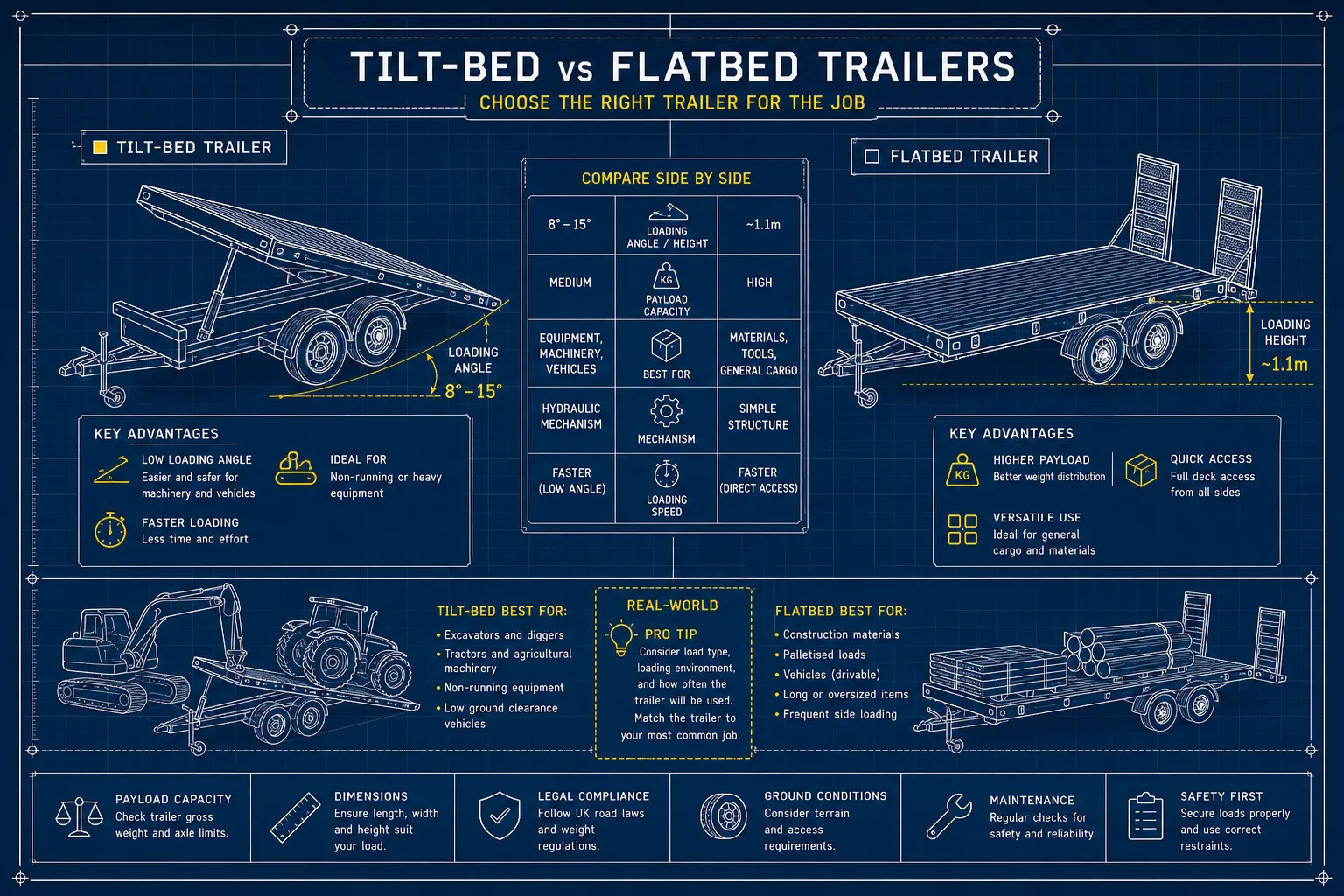
On a tilt-bed trailer, the deck itself pivots towards the ground using a hydraulic or mechanical system. Depending on deck length and model, this produces a loading angle of roughly 6° to 14°, figures that reflect typical manufacturer specifications across common UK trailer models, with longer decks generating shallower angles. The entire bed becomes the loading surface, and because the gradient is controlled by the mechanism rather than improvised with equipment, the approach is predictable every time. There are no separate ramps to position, no risk of a ramp slipping sideways, and no awkward transition point between the ramp and the flat deck. For more on how tilt geometry affects loading performance see understanding tilt angle.
The ramp setup on a standard flatbed
A flatbed deck stays level and sits at a fixed height above the ground. Loading requires separate ramps, and the effective angle depends entirely on ramp length, trailer deck height, and how carefully the ramps are positioned. Longer ramps reduce the loading angle; shorter ramps steepen it. Unlike a tilt-bed, the angle is not a fixed specification. It is a variable the operator controls through ramp choice and positioning. On stable, flat ground with long ramps, a flatbed can be perfectly manageable. In tighter or more uneven conditions, that variable becomes a liability.
Tilt-Bed vs Flatbed: Which Is Easier to Load on Tight Sites?
For certain loads and site conditions, a tilt-deck trailer is typically the easier option, particularly for wheeled, low-clearance equipment and constrained working environments. Understanding those scenarios helps you decide whether the tilt system’s benefits outweigh its trade-offs for your typical use.
Wheeled loads that struggle with ramp transitions
Cars, ride-on mowers, ATVs, and compact tractors all have a defined ground clearance that a steep ramp transition can exceed. When a machine transitions from a ramp angle onto a flat deck, there is a moment where the front wheels drop and the rear of the machine rises. For long or low machines, the undercarriage can scrape or ground out at that exact moment, this is the breakover point. A tilt deck eliminates the breakover because the deck is still angled when the machine reaches the rear, meaning there is no sudden change in plane for the machine to bridge. Solo loading is also significantly safer, because there are no ramps to shift, kick out, or slide under load.
Low-clearance equipment on tight sites
On driveways or urban building sites where run-up room is limited, a tilt bed allows the operator to position the trailer close to the equipment and drive straight on at a controlled, shallow angle. Machines with long overhangs, such as small excavators or wide-deck mowers, face considerably less risk of grounding out mid-approach. The predictability of the angle is the real advantage here: it does not change based on who set up the ramps or how flat the ground is, which makes it reliable regardless of the operator’s experience level.
When a Flatbed with Ramps Is the Better Call
A flatbed trailer is not simply the less convenient alternative. For the right operator loading the right cargo, it often delivers more practical value than a tilt-bed setup. The key is understanding where that value actually lies.
Payload capacity and what the tilt mechanism costs you
The tilting mechanism adds weight to the trailer’s own structure, and that weight comes directly out of your available payload. Flatbeds carry fewer mechanical components and generally offer a higher usable load limit at the same gross vehicle weight. For operators regularly working near their towing vehicle’s capacity, that extra payload headroom is often worth more than loading convenience, particularly when the cargo does not require ground-level loading in the first place. This is worth confirming against your actual cargo weights before committing to a purchase, rather than discovering the shortfall at a weighbridge. Manufacturer guidance on trailer weight and tare figures is useful when you’re checking the full payload chain.
Versatility and ramp control on stable ground
On a flat, stable surface such as a yard, workshop floor, or level car park, ramps give the operator genuine flexibility. By choosing a longer set of ramps, the loading angle can be made shallow enough for most equipment without the mechanical complexity of a hydraulic tilt system. For operators who rarely transport low-clearance machines and prioritise maximum carrying capacity over ease of loading, a flatbed with solid ramps is frequently the more practical and cost-effective setup. There are also fewer components to maintain, which matters for buyers who want a trailer that works with minimal upkeep.
Ground Clearance and Approach Angle: The Factor Most Buyers Overlook
Trailer specifications only tell part of the story. The operating environment has as much influence on loading ease as the trailer’s design, and this is the factor that catches buyers out most often.
How site conditions change the equation
A tilt-bed’s advantage over ramps narrows considerably on perfectly flat, smooth ground where ramps can be set up easily and left undisturbed. It widens considerably on uneven terrain, sloped driveways, or compact building sites where positioning ramps safely requires multiple attempts. The key question is not simply “what is the trailer’s loading angle?” but rather “what is the total path from ground to deck, including any breakover point, given the actual conditions on this site today?”
The breakover risk that catches operators out
The breakover point is the moment a machine transitions from the ramp incline onto the flat trailer deck. For machines with a long wheelbase, low ground clearance, or significant rear overhang, this transition is where scraping, grounding, and tipping risk is highest. A longer wheelbase combined with a higher trailer deck dramatically increases the chance of the underside making contact with the ramp-to-deck junction. That point of contact is where scrapes and ground-outs most commonly occur. A tilt deck removes this risk because the deck remains angled as the machine boards and only levels once the load is fully on. For anyone regularly transporting cars or compact plant machinery, this single detail frequently settles the debate.
Payload and Ease of Loading: Tilt-Bed vs Flatbed
This is an area where buyers sometimes get a surprise after purchase, so it is worth addressing directly before the decision is made.
Matching trailer capacity to your towing setup
A trailer’s gross vehicle weight is only half the picture. Your towing vehicle’s maximum towing capacity and nose weight limit must both be within legal and mechanical limits, and both figures interact with the trailer’s empty weight. Tilt-bed trailers are still capable of carrying substantial loads, with some models rated for several thousand kilograms of cargo, but confirming the full payload chain before purchase prevents problems at a weighbridge or during a roadside inspection. RightFit Trailers’ free budget evaluation covers exactly this check, matching your towing vehicle’s capacity against the trailer options that fit your use case.
Safety Checks That Apply to Both Trailer Types
Whichever loading system you choose, the securing requirements under UK road transport regulations apply equally. Getting this right protects your cargo, other road users, and your operator’s licence.
Securing wheeled loads correctly
For cars, mowers, and ATVs, wheel chocks and four-point tie-downs are the baseline. GOV.UK guidance on load securing specifies that wheeled vehicles require four points of contact, achieved through combinations of chocks and lashing straps, with lashings preferred where chocks cannot be used reliably. Vehicles are commonly secured with these four points of contact, and lashings should attach to structural anchor points rather than to rub rails or lightweight bodywork wherever possible. Working load limits on straps must meet or exceed the cargo weight before any journey begins, and a winch assists controlled, solo loading on tilt-bed designs where the operator needs to tension straps without a second person present. For more detail on practical tie-down requirements and recommended configurations, consult specialist guidance.
Anchor points, strap ratings, and pre-load checks
Flatbed operators should use stake pockets, D-rings, or winch rails as anchor points and inspect them for wear or corrosion before each load. For loads exceeding three metres in length, additional tie-downs are required under UK transport regulations, and loads that can roll must be blocked, chocked, or wedged to prevent forward movement. A brief walk-around check before moving off covers the essentials: anchor point integrity, strap tension, and any cargo overhang that requires marking. This check is non-negotiable, regardless of how short the journey is. Practical advice on maintaining and inspecting trailer anchor points is worth reviewing as part of your pre-departure routine.
Choosing the Right Trailer for Your Load
The decision framework is straightforward once you apply it to your actual use case. Choose a tilt-bed trailer if you regularly load low-clearance wheeled equipment, work on tight or uneven sites, or load solo without a second person to manage ramps. Choose a flatbed with ramps if you need maximum payload flexibility, load on stable and predictable ground, and your cargo does not require ground-level access to board safely.
There is no universal answer, because the easier option in any tilt-bed trailer vs flatbed comparison depends on the specific combination of what you load, how your sites are set up, and how reliably those conditions stay the same. A landscaper loading ride-on mowers from a residential driveway daily will find a tilt-bed earns its keep quickly. A builder transporting heavy plant to level, open yard sites may never need one.
If you are still weighing up which loading system fits your specific equipment and vehicle, RightFit Trailers takes the guesswork out of the decision. For a personalised tilt-bed vs flatbed recommendation, which is easier to load for your kit, start your free evaluation at RightFit Trailers and get a straightforward recommendation based on your actual setup.
Frequently Asked Questions
Is a tilt-bed trailer easier to load than a flatbed?
For wheeled, low-clearance equipment and constrained or uneven sites, a tilt-bed is typically easier to load because it eliminates the ramp-to-deck transition and provides a consistent loading angle. On flat, stable ground with long ramps, the difference narrows considerably.
What is the main disadvantage of a tilt-bed trailer?
The hydraulic or mechanical tilt system adds structural weight, which reduces the usable payload compared with a flatbed of equivalent size. This payload trade-off is the primary reason some operators choose a flatbed despite the extra complexity of ramp setup.
Do I need loading ramps for a tilt-bed trailer?
No. The deck itself tilts to create the loading ramp, so separate loading ramps are not required. This is one of the key practical advantages of a tilt-bed design, particularly for solo operators.
What does “breakover point” mean when loading a trailer?
The breakover point is the moment a machine transitions from the ramp incline onto the flat trailer deck. It is the highest-risk moment for long or low-clearance machines, where the undercarriage can scrape or ground out. A tilt deck removes this risk by keeping the deck angled until the load is fully aboard.